

After that blog post that was a slow-song, tearjerker, I think we’re all in the mood for a dance number.
Several weeks ago when I was in Gorda Sound on the Island of Virgin Gorda, BVI, I had a beautiful and photogenic beach walk on Prickly Pear Island.
I find that when I get to a new location, if there is a marina nearby, it’s nice to spend a night or two in it and orient myself to the area before setting out on the anchor. Gorda Sound is (was?) the home of the very well known Bitter End Yacht Club. For my Chautauqua friends, Bitter End is where our sailing buddy Mac worked for a season teaching sailing. Unfortunately, Bitter End was devastated by Hurricane Maria and is still closed. The picture below highlights the challenges and timeframes of rebuilding after such devastation, especially on an island where all materials have to be delivered via small cargo ships.


“Reopening October 9, 2017”
That was too bad for me as I had heard great things about Bitter End and was hoping to stay there. If I had been able to stay there I was going to keep it on the down-low that I know Mac, since—having the attributes of a sailor—he can wreak his own form of devastation.
I did spend a couple nights at the Leverick Bay Resort & Marina and it was very nice.


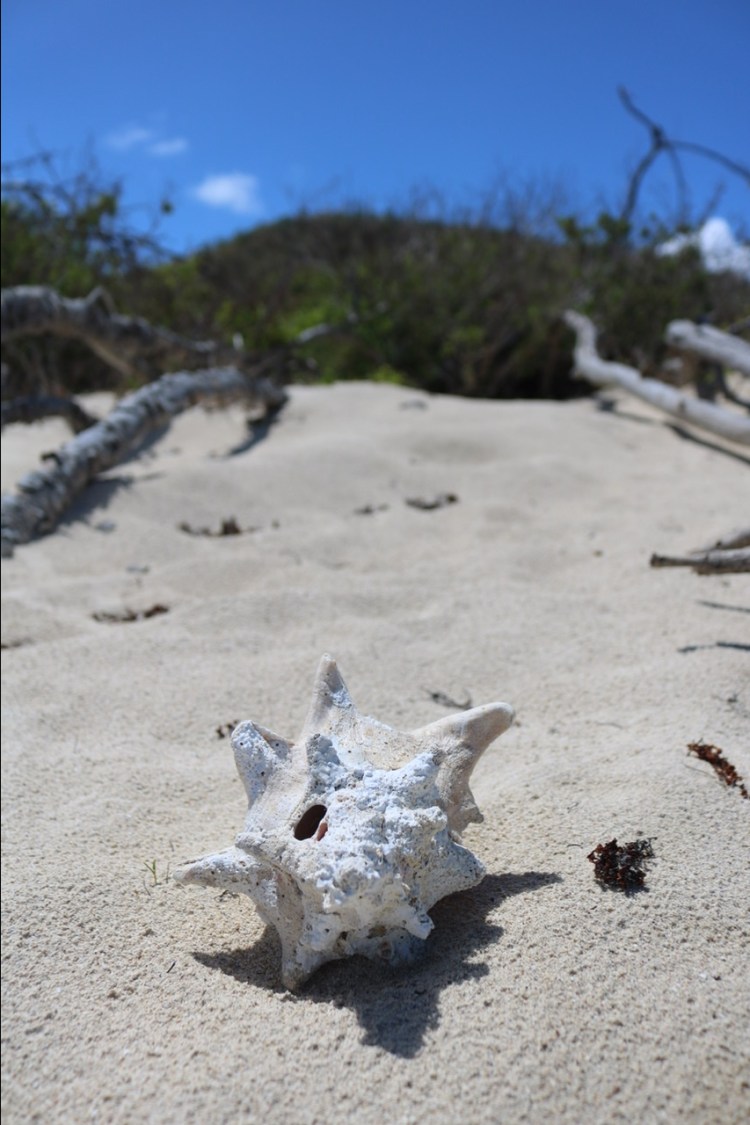
Two things struck me about the secluded beaches of Prickly Pear Island. The first was the stark beauty of the sand- and salt-bleached dead trees. These trees were likely uprooted by Maria, washed high on the beach with the storm surge and have been there ever since. The second were the conch shells. There were some beauties in pristine condition that I took with me and later made into conch-trumpets for the sunset blowing of the conch shells (more on that coming in a later post). However, I found that the older shells, disintegrating into sand, had their own special charm.


The next set of photos are the slowly disintegrating conch shells.
You’ll notice the prominent hole in the crown of the conch shell immediately below, this tells us that the builder of this shell did not die a natural death. When a conch fisherman “catches” a conch (i.e., picks it up off the bottom, generally in 3-20 feet of water), they use a ball peen hammer to make the hole seen below. They then insert a narrow knife (like an oyster knife) and cut the conch’s muscle that attaches the conch’s body to its shell, and the body of the conch slides out.



Finally, I got to this section of the beach with innumerable conch shells that were much newer and in better shape. I was reminded of my Uncle Bill who was an avid shell collector. I imagine his little corner of heaven looks something like this.

Take care and stay isolated and healthy. Our little bay was just patrolled by a BVI Immigration boat for the second time in as many days so the BVI government is taking the curfew-lockdown seriously which is a good thing.
In looking back through my journal and ship’s log, I anchored in Little Harbour on March 26th—20 days ago. At the moment, the curfew is to be lifted this coming Monday (April 20th). We just got a tentative announcement from the BVI government that between April 20th and June 2nd residents and guests will be able to move about the country only for essentials. Given that, I’m going to look into sailing for home soon after the 20th. I need to do some limited reprovisioning and wait for a good weather window but those things shouldn’t take more than a week.
Funny, the BVI government announced this news on Facebook. Their post ends:
Medical hotline remains in place. Anyone with cough and fever, or difficulty breathing, asked to call. Only 5 people reported to remain in mandatory quarantine here. Total ventilator ICU bed capability in BVI: 9 – Wash your &$%#ing hands.
It’s funny that up until the pandemic I was having an expected-adventure. While everything was great, nothing was too far from plan or what I expected. Since the pandemic and lockdowns, I and my harbormates have been thrown into unexpected-adventure. One thing I’ve discovered is that being anchored in one place for such a long time with minimal interaction is a very Henry David Thoreau and Walden-like experience. In addition, perhaps the mere concept of expected-adventure, is—itself—an oxymoron.
Hazel James out.