The Voyage: What I Learned, How I Grew

“What you get by achieving your goals is not as important as what you become by achieving your goals.”
—Henry David Thoreau

I discovered this quote when reading Diana Nyad’s inspiring autobiography Find a Way. She achieved her goal as the first person to swim the 111 miles between Havana, Cuba and Key West, Florida, and she achieved it on her fifth attempt and at the age of 64.

The other night, I was talking to a friend who follows this blog. She asked, “So, when you write your next post about what you learned and how you grew, what are you going to write about?” I’m not the quickest with extemporaneous words but still, found myself surprisingly speechless. I told her that I had a collection of somewhat random notes jotted down and really needed quiet time to sit and pull the story out of them. Although arduous, the process reminds me of Michelangelo’s words:

“The sculpture is already complete within the marble block, before I start my work. It is already there, I just have to chisel away the superfluous material.”

One overall thing that I’ve struggled with a bit since I arriving home on Mother’s Day, is that life feels a little flat. While it’s absolutely thrilling to take a hot shower whenever I want, or to have a bit of ice cream after a good dinner, or to sleep soundly knowing that your bed isn’t on a floating object that has the distinct possibility of breaking-loose and drifting away during the night—life also feels a little plain, a little normal, a little flat.

While I’m back at home I’m focusing on a major refit of Hazel James to prepare her for our next voyage. However, in that process, I feel the gravitational pull of returning back to a normal land-based life. I think about the physicist’s “escape velocity”, defined as the minimum speed needed for a non-propelled object to escape from the gravitational influence of a massive body (for the earth, it’s about 11,000 miles per second, rockets don’t need to reach that speed since they are internally propelled). Speaking conceptually and metaphorically, and not as a physicist, I wonder if I’ve reached escape velocity from land-based life or if I was ever-so-close but have now fallen back to earth permanently. I suppose that’s one of my future challenges.

Anyway, let’s get back to the point of this post, what I learned and how I grew:

Lesson #1: For God’s Sake, Secure the Bitter-End of All Halyards – Every working line on a boat has two ends, the running-end that leads to the sails, pulleys, etc. (i.e., whatever the line is meant to secure or control), and the bitter-end (i.e., the other end of the line). A “halyard” is a line that runs to the top of the mast and back down again and is used to haul a sail up the mast.

The term comes from traditionally rigged boats with four-corner sails. The wooden boom at the top of the four-cornered sail is the “yard” and the line used to haul the yard up the mast began to be called the “haulyard” which was then shortened to “halyard”.

Hazel James carries four halyards: one for the mainsail, two for the two headsails and one for the spinnaker. On the afternoon of my first day of sailing home on this most recent passage, I attempted to hoist the spinnaker in 15 knots of wind—the maximum sensible wind for this sail. I neglected to secure the bitter-end of the spinnaker halyard and lost it in my tussle with the recalcitrant half-inflated spinnaker.

In retrospect, it was kind of funny to lose control of the bitter-end of the line and watch it snake up the mast. Then, look down dejectedly at the deck of Hazel and, a few seconds later, the entire halyard lands on the deck with a plop. As I had said in my pre-passage blog posts, I was looking forward to flying the spinnaker a lot on my passage home and my first thought was that I would need to make do without it given I now had no suitable halyard at the top of the mast from which to fly the spinnaker. However, less than 24 hours later, I found myself in very light winds when I really could use the spinnaker. It was at that point that I decided to climb the mast with the halyard to get it back through the block (pulley) at the top of the mast.

Now Hazel, as a well-found cruising yacht, has fold-out steps on the mast. I also have a bosun’s chair—think of it like a rock climber’s harness—to help hold me to the mast. I’ve climbed up her mast many times in protected water but had never done so in the open ocean. Her mast height is about 47 feet and, as you might imagine, minor rocking of the boat in the ocean at the deck level is magnified many times 40-some feet off the water. Bottom-line, I successfully climbed the mast and got the halyard re-set. I then successfully hoisted the spinnaker and was on my way with significantly improved boat speed!

Lesson #2: For God’s Sake, Keep Your Halyards in Good Shape and Replace them Before They Break – At this point, you’re probably thinking, “Uh-oh…I know where this is going”, and yes, you are right. A couple days after I climbed the mast to re-set the halyard, I found myself up there yet again after the halyard broke. The good news about both incidents is that I have people to blame. In the first case of losing the halyard up the mast, I squarely blame the sail-handler aboard Hazel. In this second incident, the broken halyard, I lay the blame squarely at the captain’s feet for inadequate maintenance of critical running-rigging. Not only do the halyards take a bit of stress when sailing, particularly the spinnaker halyard, the rest of their lives is spent baking in the sun. The deterioration from the ultraviolet light is significant.

The funny thing is that I knew the halyard wasn’t in great shape and I was planning to replace it (and all the other halyards) during this summer’s re-fit. As I was climbing up the mast the day before with the halyard, I said to it, “You get me through the rest of this passage and I will retire you with full honors.” When it broke, we were bubbling along in 10 knots of wind, just perfect for the spinnaker. It was a sunny midday and I was below decks doing the dishes in the galley with the stereo cranking a song by The Clash. In the midst of that perfect moment, I hear a BANG and I knew what was going to happen next before it happened: I looked out the galley porthole and saw the spinnaker fall into the water next to the boat. While the good news is that there were people to blame for these mistakes, the bad news is that I’m a singlehanded sailor and serve as sail-handler, captain and other positions (cook, navigator, etc.). Long story short, I rigged our spare halyard and climbed the mast with it.

For those of you good at math, by now you’ve probably calculated that I’d been up the mast twice during the passage. I’m happy to report that there was no third time. I will say though that while 47 feet doesn’t sound like a long way, when it’s straight up on a 31 foot boat in the middle of the ocean by yourself—it seems like forever. While the sea-state was benign when I went up the mast, invariably a larger-than-average set of waves would pass us when I was up high. I found the best strategy was to just bear-hug the mast and wait for them to clear and for Hazel to resettle before continuing with my work.

Hazel’s spinnaker and original spinnaker halyard (green arrow points to where the halyard broke)
The broken halyard

Lesson #3: The Sea is Indescribably Immense – Most every junior-high student knows that the earth’s circumference is 25,000 miles and is 2/3rds water. However, those are just numbers. Until I sailed away from land by myself and watched terra firma disappear off my stern and was by myself for days on end with no land visible did I really appreciate the shear size and scale of the earth and the earth’s oceans. A corollary to this lesson is that to think that we, the human race, is responsible for warming the earth’s oceans is also difficult to comprehend. While science has proven that human-caused global warming is true and that climate-change denialists are ostriches with their heads in the sand, it’s still hard to wrap your mind around after you’ve floated on the ocean by yourself for days.

Lesson #4: “It’s People” – (…to quote Charlton Heston’s last lines from Soylent Green). While I saw wonderful new things on my voyage and had solitary experiences that were utterly new to me, my most-sailent memories are of the people and the friends I made. It’s also interesting to me that looking at blog-post feedback from all of you, while the technical stuff about sailing and celestial navigation is interesting, and so are the travelogue posts—what was the most intriguing were the stories of other sailors and the stories of Colleen and me and our grief.

Building on the people theme, I also learned that sailors—and I like to think of me included—are such a fascinating cocktail of self-reliance mixed with unmitigated helpfulness. If you’re doing it right, when you are in the middle of the ocean you should know how to troubleshoot and fix every system on your boat, and get by without it if you can’t fix it. Conversely, a true sailor will do absolutely anything for another sailor if they are able to assist. When I was quarantined in Little Harbour for that month, I couldn’t swim or paddle by one of the bigger yachts without getting offers of food, drink, water or anything else I needed. When Go & Lan and I were simultaneously preparing for our passages, I inventoried my ship’s stores and knew I was way over-provisioned for my 10-day sail home…I gave Go&Lan a big bag of dried and canned goods that I’m sure they have put to good use.

Quick aside…Speaking of Go&Lan, yesterday I got a video message from Gautier and Lancelot. They have reached the Azores after 24 days of upwind sailing. I was so good to hear from them and I hope to talk to them in the next day!

Lancelot and Gautier’s selfie with the Azores in the background

Also, I just heard from my friend and former harbormate Zoltan that he reached Gibraltar after 30 days of singlehanded sailing and a stop in the Azores. Zoltan is from Transylvania but set-sail from Croatia so he’s “nearly” homefree now that he’s in the Mediterranean (distance is all relative).

Gibraltar taken by Zoltan

Lesson #5: I Really Like the Voyaging Lifestyle and Like Earning My Distance on this Earth – While I talked about these concepts hypothetically when I opened this blog, I really didn’t know much. Now, after 115 days at-sea on a boat, I’m determined to do more of it.

In writing about trains and travel in the 19th century, the art critic, philosopher and social thinker John Ruskin (1819-1900) said, “All traveling becomes dull in exact proportion to its rapidity. Going by railroad I do not consider traveling at all; it is merely ‘being sent’ to a place, and very little different from being a parcel…. But if, advancing…slowly, after some days we approach any more interesting scenery…the continual increase of hope…affords one of the most exquisite enjoyments possible to the healthy mind; besides that real knowledge is acquired of whatever is the object of traveling to learn, and a certain sublimity given to all places, so attained, by the true sense of the spaces of earth that separate them.” Sailing through the ocean at 5 knots has begun to give me the true sense of the spaces of earth that separate our destinations. While I totally understand that driving and flying is a necessity for us all at some points in our lives, I’m determined to earn my distance as much as possible. The side benefit of low-carbon-footprint travel is also immensely intriguing to me.

Lesson #6: Don’t Freak Out – I first wrote about this concept after my passage from the Bahamas to the Virgin Islands and have confirmed it during my time in the Virgin Islands and on my passage home. Rodney Dangerfield used to tell a simultaneously funny and meaningful story in his stand-up routine:

A woman goes to her doctor and says, “Doc, I want to get into shape. What should I do?” The doctor looks at her medical history and says, “Why don’t you try walking two miles a day?” The woman calls her doctor a month later and the doctor says, “Well, how is it going?” She says, “The good news is that I feel great—the not-so-good news is that I’m 60 miles from home.”

There is an element of that to long-distance sailing and—in retrospect—there’s an element of that to the early stages of grief. Fortunately, after Colleen died, my sleep was never overly-impacted. Yes, I’d have some sleepless nights and some dark-nights-of-the-soul but, in general, I slept pretty well in the first months after she was gone. However, in that early-morning, dreamlike, interstitial time between sleeping and wakefulness, in a semi-conscious state I’d say to myself, “Something is horribly wrong in my life but I don’t know what it is.” After some minutes of thinking, processing and becoming further conscious, I’d remember and say, “Oh, that’s it…Colleen is dead and is never coming back.” Although an unlikely teacher, Rodney Dangerfield’s lesson was to not freak out. Just get up every day and walk that two miles and be confident that you will feel just a tiny bit better at the end of the day.

The same goes for long-distance sailing. In some ways it’s no different than an extended series of day-sails. Don’t get freaked-out by the enormity of the ocean or the enormity of the distance to be travelled—just take it easy and focus on sailing one tiny bit of the ocean at a time.

In going deeper, it’s the same for the super-humans who are in addiction recovery, like Colleen. They don’t think about staying sober forever. It’s too big, too daunting. Instead, they focus on staying sober one-day-at-a-time. On a bad day, they know to further-narrow the aperture to staying sober for the next hour…or even the next five minutes. When the sailing gets tough and the weather is rolling in, just focus on getting through the storm’s initial front. If you’ve prepared well, trust that the rest will take care of itself.

Lesson #7: What Life Wants Is Not It’s Own Love back in Copy Speech, But Counter-Love, Original Response – If that sounds incredibly poetic—almost too good to come from your friend Dan—you’re right. It’s from Robert Frost and his poem The Most of It:

He thought he kept the universe alone;
For all the voice in answer he could wake
Was but the mocking echo of his own
From some tree-hidden cliff across the lake.
Some morning from the boulder-broken beach
He would cry out on life, that what it wants
Is not its own love back in copy speech,
But counter-love, original response.

And nothing ever came of what he cried
Unless it was the embodiment that crashed
In the cliff’s talus on the other side,
And then in the far distant water splashed,
But after a time allowed for it to swim,
Instead of proving human when it neared
And someone else additional to him,
As a great buck it powerfully appeared,
Pushing the crumpled water up ahead,
And landed pouring like a waterfall,
And stumbled through the rocks with horny tread,
And forced the underbrush — and that was all.

While I had a wonderful time by myself as a singlehanded sailor and learned so much about myself, at-times I felt that “mocking echo of my own”, and yearned for counter-love, original response. I’ve got to think about that one more.


To close this post, I’d like to first thank all of you for following along on this voyage and for your public and private comments. You gave me that virtual counter-love and original response. Your support during this time in my life has meant the world to me.

The natural closing question to the voyage is, “What’s next?” Well, I have a couple thoughts there:

First, I have several other travelogue blog-posts from the voyage half-completed and I want to finish and post them.

Second, as mentioned above I am going to spend the summer (which is also hurricane season) at home in Pompano Beach and focus on a major re-fit to Hazel. Think of it as a well-deserved, summer-long spa for this 30 year-old girl. I’d like to post on that and the adventure of a sailor doing a re-fit to a yacht themselves. It’s different than just taking your yacht to a boatyard and paying a lot of money to have all the work done by others. It’s a similar concept to “earning my distance” and will also give me a more intimate knowledge of Hazel and increase my self-reliance at sea. Here’s where we are at the moment and a preview of coming attractions…

Finally, I’d like to start talking about the next voyages that I’m envisioning. Similar to this past voyage, telling all of you what I am planning will help keep me honest and true to attaining my dreams. I’m eternally grateful to all of you for that.

Fair winds and following seas…

Back in the Saddle!

So you run and you run to catch up with the sun but it’s sinking,
Racing around to come up behind you again….

Every year is getting shorter never seem to find the time.
Plans that either come to naught or half a page of scribbled lines
.

—Pink Floyd, Time, added to the hjsailing playlist

Ahoy friends! I’m back in the blog-saddle after a several week hiatus to sort out some land-based-life things. I appreciate your patience and continued readership. It’s fascinating to see what undone stuff stacks-up after 4 months at sea.

In this blog post, I’ll cover the more technical, numerical and logistical aspects of my passage home from the British Virgin Islands. In my next post I’ll focus on the “softer side” of the passage and the voyage—that is, what I learned and how I think I changed during my time voyaging.

First, let’s start with the numbers for both the passage home and also for the entire voyage. The non-stop passage home from the BVI ended-up being a 9 3/4 day sail covering 1,090 nautical miles (1,250 statue, or land-based, miles). That makes an average of 4.7 knots (nautical miles per hour)—not bad considering I had several extended periods of being becalmed and chose wait for wind rather than motor. My top speed over ground (SOG) for the passage was 11 knots. This was off the coast of Miami when I had the combination of strong winds in a favorable direction and the Gulf Stream pushing me.

Looking back at the entire voyage, I slept all 115 days on Hazel James and sailed a total of 2,500 nautical miles. This included 283 hours of singlehanded night sailing.

On the passage home, my sailing was generally westward in the tradewind belt. Since the tradewinds blow from the east, my sailing was generally downwind. When sailing downwind with winds above 15 knots, I’d sail with Hazel’s two headsails “wing-on-wing”. When the wind was below 15 knots I would fly her spinnaker. While the spinnaker really gets the boat moving in lighter winds, it’s a big sail and you want it down before the wind builds too far or a storm sets in. Any crew—especially a singlehanded sailor—can get into a bit of trouble trying to carry a spinnaker in high winds.

Hazel’s two “headsails” (the sails ahead of the mast) poled-out “wing-on-wing”, good when the wind is >15 knots
Hazel’s spinnaker flying. For those of you into the technical aspects of sailing, this is an asymmetrical spinnaker or gennaker (cross between a genoa and spinnaker), good when the wind is <15 knots

Sailing downwind is called “running”. Running to the west day-after-day reminded me of the Pink Floyd song “Time”. For a series of days, the sun sets off the bow (front) of the boat and ten hours later rises off the stern (back of the boat). With that repeated pattern of the sun—combined with the waxing moon, and circumpolar stars wheeling around Polaris (the north star)—you truly get a sense of the earth spinning through space and your tiny, and ever-so-brief place on that earth.

As I thought about the other lyrics of the song, I smiled at the lines:

Every year is getting shorter, never seem to find the time.
Plans that either come to naught, or half a page of scribbled lines
.

I was so happy that I had actually found the time, the 115 days, to make this voyage—this dream—a reality. While I can be so sad, and just about cry on-demand when I think about my sister Amy and wife Colleen dying, I’m happy that their final gift to me was the courage to unplug and the courage to take that step off the dock and onto Hazel James in January and go sailing.


Rewinding to the preparation for—and beginning of—the passage, the afternoon and evening of Tuesday, April 28th was my last night on Peter Island. To celebrate, I went for a hike with harbor-mates that I had been in quarantine with for the past month and enjoyed the sunset. My friends Kim and William then treated me to a wonderful dinner on their boat.

Hiking on the evening of my last night on Peter Island (Hazel James is the smallest boat in the photo, third from the top)
Sunset on my last evening

The next morning (Wednesday, April 29th) I made the 4-5 mile sail across the Sir Francis Drake Channel from Little Harbour, Peter Island to Road Harbour, Tortola. Given the pandemic, The BVI authorities were carefully monitoring all ship traffic in the area and I had gotten approval to move Hazel James for the purpose of reprovisioning. It was a real shock to my system to go from the deserted Peter Island to bustling but masked and socially-distanced Road Harbor/Road Town. My French friends Gautier and Lancelot had repositioned to Road Harbour the day before so I found them in the harbor and anchored-up next to them.

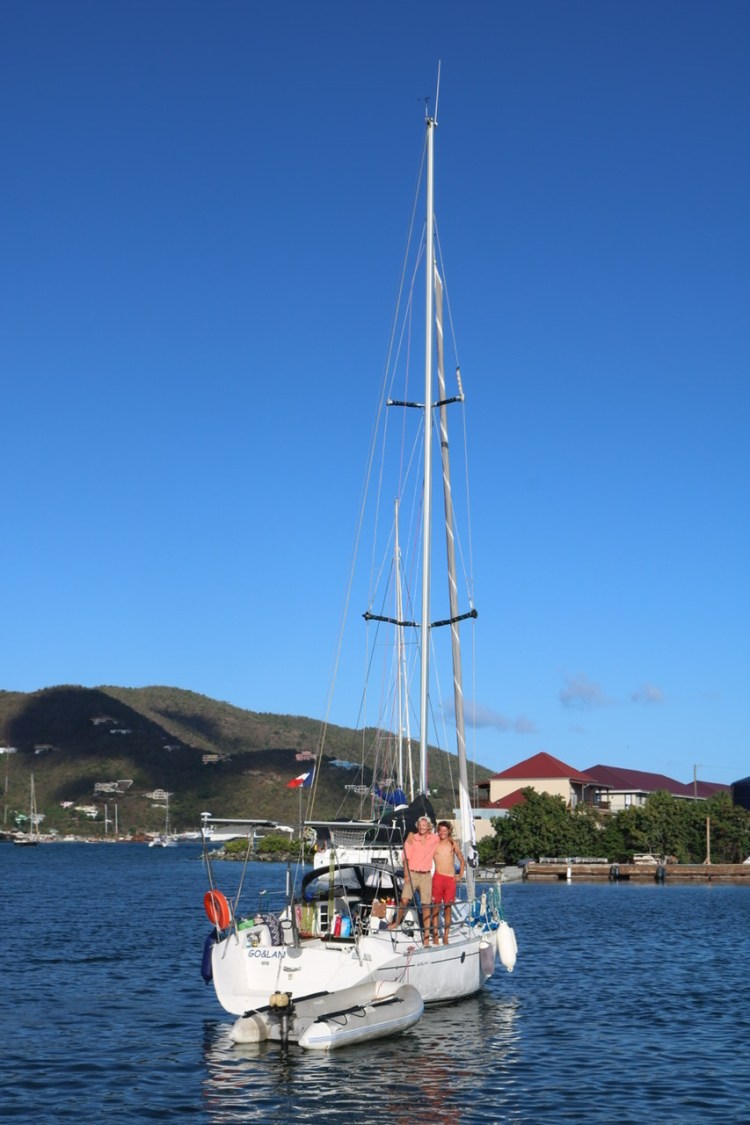
Gautier and Lancelot aboard Go & Lan in Road Harbour, Tortola

In Road Harbour the economic impact of the pandemic was startling. If you look carefully in the background of this picture, you will see all the many, many masts of mothballed charter yachts. Each one of those masts represents about $25,000 of lost revenue per week to the islands, and this is just one harbor in the Virgin Islands, and there are many more islands in the Caribbean.

Mothballed charter yachts in Road Harbour

The next morning, Thursday, April 30th, I weighed Hazel’s anchor (pulled the anchor off the bottom) and swung Hazel close to Go & Lan to say my goodbyes. When I did, I threw Gautier and Lancelot, two yachting caps as good luck for their 2,300 nautical mile passage to the Azores (followed by a 1,400 nautical mile passage from the Azores to France)—with distances like that, good luck is required. As I motored off toward the harbor mouth, Gautier and Lancelot gave me a good blow on their conchs that reverberated through the harbor.

Gautier and Lancelot with yachting caps on and giving me a good conch blow (note the hurricane damaged and derelict boats in the background)

Here are a couple parting shots of Hazel James taken from Go & Lan.

On my sail from Road Harbour to West End, I watched Little Harbour be enveloped in a rain shower and thought of the month I had spent there and great friends I had made. I also of the lines from the Harry Nilsson song Everybody’s Talking: “I’m going where the sun keeps shining, through the pouring rain. Going where the weather suits my clothes.”

Looking south on my sail from Road Harbour to West End. Little Harbour is on the right (you can barely see the masts of boats in the harbor). A rain shower is moving from the east to west about to reach Little Harbour.

I also thought of the Dr. Seuss quote that has comforted me with Colleen’s death: “Don’t cry because it’s over, smile because it happened.” Even so, I couldn’t help but tearing-up thinking about all the friends I had made there and if, and when, I would see them next.

The clearing-out process with BVI customs and immigration at West End was straightforward given I had a scheduled appointment. I then sailed out of West End and set a course for my first waypoint, some 300 nautical miles to the west.

Throughout the passage home I stuck fairly close to my charted course but took the opportunity to deviate here-and-there to take advantage of the wind. The images below illustrate my passage on my GPS chartplotter and on my traditional paper chart.

The pink line is my actual track home (the black line is my track from the Bahamas to Virgin Islands back in February)
If you look carefully, you’ll see my intended course in a dotted line and actual course in solid line

On our first night out, with a combination of nighttime rain shower and waxing gibbous moon, I saw a “rainbow” caused by the moon. I’d never seen that before and may never see it again. It’s fascinating on a boat far from land, you see things that you would never see otherwise. In the moonlight, the rainbow didn’t have the classic rainbow colors, but it did have a full spectrum of grays that was eerie, beautiful and haunting.

The next morning, Friday, May 1st, I was off the coast of San Juan, Puerto Rico and encountered a bit of ship traffic waiting to get into the port of the capital city of Puerto Rico. I elected a close-quarters crossing of the bow of the 193 meter freighter Desert Peace. I could see both visually and on my AIS (Automatic Information System) that she was idling into the wind at ~1 knot, and heard her on the radio conversing with the US Coast Guard regarding entering the Port of San Juan so I knew she wasn’t going anywhere. Given that information, and that it was daylight with good visibility, I chose to cross her bow. I wouldn’t cross that close ahead of a large ship if she were moving at speed.

Looking right down the bow of Desert Peace
Desert Peace from an angle

Two days after passing San Juan, Puerto Rico, (Sunday, May 3rd) I could just barely see Hispaniola (the island of the Dominican Republic and Haiti) 30 miles to the south.

Land ho! Hispaniola faintly visible in the distance

On Tuesday, May 5th, my sixth day of sailing, I passed close to Great Inagua Island. Anyone reading the book “Into the Storm” that I recommended will know how centrally the US Coast Guard base on this Bahamian island plays into the story.

Great Inagua Island on my GPS
The Great Inagua lighthouse several miles distant

For those of you interested in a bit more of a first-hand experience of what it’s like on the open ocean, I took two videos while sailing that should be helpful. The first is from Hazel’s foredeck sailing in 22 knots of wind. The second was taken shortly after below deck in her saloon.

After I cleared Great Inagua Island, I was off toward the Old Bahama Channel. It’s a relatively narrow channel of deep water with Cuba to the south and the Great Bahama Bank to the north. While I approached the channel with some trepidation given what I had heard from other sailors, I found the transit to be easier than expected. The sailing was smooth and there was plenty of room outside the main shipping channel where I could navigate without getting too close to the shipping traffic. My sense is that the shipping traffic was a lot lighter than normal with the pandemic and—of course—there were no cruise ships about.

After exiting the Old Bahama Channel I sailed up on the Great Bahama Bank for 60 or so miles. That was pretty bizarre. There was no land in sight, yet I was sailing in a consistent 7-8 meters of water. Given the clarity of the water and that I was sailing fast at 6+ knots, I could see the coral and sand bottom streaming under me. While all my charts showed safe water all around, it took me a half hour or so of sailing on the bank to calm down and relax. It would be bad enough to hit a coral head a couple miles offshore; it would be disastrous to do so far, far away from anyone else. I trusted my charts and my navigation and was fine. Still, I was happy when we sailed off the bank and into deep water on the other side.

After my sailing on the Great Bahama Bank, I was so close to my destination of Hillsboro Inlet and home. I started doing some calculations to estimate my arrival time and guessed I would arrive home the afternoon of Mother’s Day, May 10th. I thought about the coincidence of arriving home on that day, our first Mother’s Day without Colleen.

On my final leg, I managed to catch a nice pelagic barracuda. “Pelagic” being that it lives in deep ocean water. While reef-dwelling barracudas are prone to being contaminated with ciguatera toxin that causes a nasty poisoning if consumed, pelagic barracudas are safe and quite tasty. I had lemon-pepper poached barracuda for lunch and barracuda ceviche for dinner!

Nice pelagic barracuda

While my predictions were correct about making landfall on Mother’s Day, I was way off on the time. While I originally thought I would arrive in the afternoon, on my final night of the passage the wind really picked up and shifted favorably. In addition, I was in the middle of the Gulf Stream that added another 3-4 knots to my speed over ground. I began seeing the light of the Hillsboro Inlet lighthouse around 2 AM of Mother’s Day and reached the inlet around 4 AM. I fired-up the engine for the first time in 10 days and motored home to a big welcome from my son Jack and his girlfriend Jessica and a much, much, much needed and enjoyed shower.

Hazel James in safe harbor after 2,500 nautical miles

That’s it for the logistical side of the passage. In my next post, I’ll try to explore what I learned and how I think I have been changed by the entire voyage.


Thanks as always for reading. Hazel James out.

There and Back Again

No person will be a sailor who has contrivance enough to get themself into a jail; for being in a ship is being in a jail, with the chance of being drowned… a person in a jail has more room, better food, and commonly better company.
—Samuel Johnson

Happy Mother’s Day everyone! Although I’m missing Colleen on this Mother’s Day and remembering all the breakfasts-in-bed and dinners to celebrate, I’m also happy to say that we completed our 1,050 mile passage home by entering the Hillsboro Inlet at 4:45 AM this morning and hailing the bridge tender on the radio to request an opening of its span for us. Between exiting the West End, Tortola, BVI harbor and entering Hillsboro Inlet, we did not use our diesel engine “Ox” once, that was a goal of mine achieved.

More to follow as I think through the passage and put it all in context—10 1/2 days of single handed sailing takes a lot out of you to say the least. For now, I just want you to know that we are in the safe harbor of home and I’m looking forward to my first sleep off of Hazel in more than 100 nights.

Thanks as always for your emotional, spiritual and—sometimes—meteorological support of the voyage.

One of the most intense double rainbows I’ve ever seen
The sun setting under Hazel’s spinnaker
This morning, I stepped off Hazel’s deck and on to our dock—the dock I stepped off of in January to start the voyage

May Your Boat Sink in Warm and Shallow Waters

Those were the parting words from my good friend William when I made my 6:30 AM departure from Little Harbour yesterday. He, Kim and Rachel paddleboarded over to wish me safe passage. Ben cast off my shore lines. I weighed anchor (pulled up the anchor) and was off!

They all had their conch trumpets with them and as I sailed off, they and my harbormates and friends gave me a rousing chorus of conch blows (I have a video of a sunset conch blows I will post when back home).

I had a lovely 3 or 4 mile sail across the Sir Francis Drake Channel to Road Harbour and Road Town. It was nice to shake-out the sails and running rigging prior to our departure. In Road Town I topped off Hazel’s diesel tanks, filled her empty propane tank (she carries two tanks) and bought $150 of fresh food for the passage.

When Go & Lan departed the morning before I departed, my final words to them were, “See you tomorrow or in the Mediterranean.” Lancelot replied, “Why not both?” We’ve satisfied half that bargain as I found them in Road Harbour and anchored next to them.

I’m having trouble finding the right words for how I’m feeling. I could call it “ambivalence”, but when I look-up the definition, “…the state of having mixed feelings or contradictory ideas about something or someone.” That’s not it. It’s more gratitude for the past three months and experiences had and friendships made, combined with excitement and anticipation with the near-term future (getting home) and long-term future (other voyages to be planned).

In a few hours I will weigh anchor in Road Harbour, set sail 6 miles to the town/harbor of West End (one of the few open BVI customs/immigration ports), clear-out of the country and start my passage home…to my back yard.

Fair winds and following seas.

Uh Oh…Busted!

The long arm of the law finally caught up with me (fortunately they didn’t have extradition papers)

OK…let’s have a quick, lightweight, fun post for a Sunday evening…

Late last week, this BVI police boat hove into view around one of the headlands of Little Harbour. While all of us in the bay were pretty sure we were doing what we were supposed to be doing, given the communications and how things are changing…you’re never quite sure. It’s also a bit disconcerting when the police boat is a good bit bigger than you! No worries though, I wasn’t busted (at least not yet). The police had a VISAR representative onboard (Virgin Islands Search and Rescue). VISAR is coordinating the maritime pandemic response for the BVI.

The VISAR representative and the police were great, they just wanted to make sure we had provisions, weren’t running out of prescription medicines, etc. She also gave me the number of another VISAR person to call this coming week to get permission to move Hazel James for provisioning and to checkout of the country. I’m getting excited to make that call tomorrow morning.

Lancelot, of Go & Lan, took the above picture and he also took the picture below when the police boat visited them.

There’s an old saying that “youth is wasted on the young”. That’s absolutely not the case with Lancelot and Gautier. Leave it to the French to clown-around with the police officer and get a selfie…

The BVI Police visiting Go & Lan

Gautier and Lancelot have a waterproof GoPro camera. When we were snorkeling the other day, they told me to dive under Hazel James and pretend I was holding her up by the keel.


I’ve said before that I don’t learn new songs on the uke lightly. With all my time in curfew, I’ve had a chance to learn or reacquaint myself with seven songs which is a lot for me. I say “reacquaint” because some of the songs I’ve messed around with for years but was never happy with how I played them so never committed them to memory or played them. Here’s a rundown of the songs and I’ll add them to the hjsailing playlist later tonight, I hope you enjoy!:

One Note Samba – A friend and I were talking about how cool sambas are. This is a nice cousin to “Girl from Ipanema” which I just love.

Nature Boy – Lately, I’ve been way into songs that are haunting, and this song is top-of-the-list in that category. I’ll add a couple different versions of it to the playlist given all the different approaches you can take to the song. The final words of the song: “The greatest thing you’ll ever learn is to love and be loved in return.”—there’s not much more that can be said to that.

Somewhere Over the Rainbow/Wonderful World – Iz’s concomitant ukulele song. This is a “reacquaintance” song for me. I’ve messed around with it for years but was never happy with it. It’s tough to sing because it requires a wide range and, in my case, a bit of falsetto. I finally landed on the key of B-flat for my voice and I’m happy with it (or at least getting happy with it).

Blue Moon – Talk about a haunting song…so good. I love what Margot Timmons and the Cowboy Junkies did with it.

Wichita Lineman – More haunting music… Jimmy Webb is such a good composer (Galveston, MacArthur Park, By the Time I Get to Phoenix, etc.). My good friend and Colleen’s brother Tim tells a great story he heard about the band REM and lead singer Michael Stipe. The band had just finished an arduous day of recording in the studio and went out with their crew for a beer after. It was karaoke night at the bar and Michael Stipe—known for being rather shy and reclusive—finally was coerced into taking the stage for one song. He picked a Jimmy Webb tune and was so pumped at the end of it that he stayed on stage and sang every other Jimmy Webb song they had.

Against the Wind – Our good friend JJ is fond of saying, “Everyone’s a closet Seger fan.” It’s another reacquaintance for me and I’m finally getting comfortable with it.

Summertime – Ahhhh, a tremendous George Gershwin tune. There’s a BVI artist Al Broderick who has been live-streaming “The Lockdown Sessions” every Saturday night. One of the yachts in Little Harbor cranks it to a nice volume and we all listen together from our respective boats. Several weeks ago he did a jammy, rhythm-heavy version of Summertime that I just loved—so much so that I worked up a uke version.

Fair winds and following seas! I’ll keep all posted on my departure plans.

I’m Comin’ Home

I’m comin’ home,
Made up my mind that’s what I’m gonna do.
Can’t love nobody on the telephone,
I’m comin’ home to you
.

—Robert Earl Keen (added to hjsailing playlist)

Author’s Note: While I still have some hurdles to clear prior to my departure and our exact embarkation date is uncertain, once the curfew is lifted, things will move very quickly and I’ll have limited time for updates. Therefore, while I was charting out my homeward course for my own benefit, I documented the process here along with my thoughts on the routing for all of you. Enjoy!

What we hope to be doing in a week or so

I was talking to one of my harbormates Rachel the other day. We got to the subject of being so-close to having the 24×7 curfew lifted and being able start moving our boats, then—at the last minute—getting word the curfew was being extended. She likened it to a dog on a fixed leash in the yard. The dog sees a cat and takes off running, single-focused on the feline. Just as the dog is about to clear its yard, the leash and collar tighten, the dog is lifted into the air, yelps and crumples back to earth—dejected. While our situation is like the dog and the leash, I and my harbormates are anything but dejected.

Several years ago, I read the book Pollyanna by Elenor H. Porter. What got me started down the path of reading it was how often in business we would refer to a Pollyanna in a negative light: as someone who just can’t conceive of anything negative in the world. As I cracked open the relatively short book, I wasn’t expecting much—I just thought it would be a fun to understand Ms. Porter’s original intent. As I got into the book and finished it, I was blown-away and it’s become one of the most powerful books in my life. In the book, Pollyanna’s situation is much more nuanced than what we throw around in a business context. While I won’t spoil it for you, a key element of the story is that Pollyanna and her father (a preacher) play a game they call, “The Glad Game”. The basic rule of the game is that when anything bad happens to you, while you accept the bad as a realist, you also consciously think about something—anything—you can be glad about. Her family is desperately poor and when Christmastime comes they must dip into the church’s missionary barrel for gifts. Pollyanna has the last gift in the barrel and she is hoping against hope for a doll. She reaches in the barrel and pulls out a pair of crutches. While Pollyanna is initially crushed, on-the-spot and in an effort to save the day and save Christmas, her father creates The Glad Game. Together, they think and think about what they could possibly be glad about. Finally, they decide that Pollyanna can be glad that she doesn’t need the crutches and furthermore, she can give them away to someone who does need them. It’s such a simple but powerful way to live a life. I read the book a couple years before Colleen died and it helped me through the dark days after her death, and helps me to this day.

My Glad Game with the 7-day curfew extension was pretty easy. It’s given my time to savor my surroundings and my harbormates. While we are all still mindful of social distancing, none of us has been out of the bay in 14+ days and the only visitors have been sanctioned food delivery (with masks and gloves) and trash pickup. That allows us to relax and talk a bit more which is precious. If we had all blasted out of here this last Monday (4/20), I wouldn’t have had this time. While there is so much tragedy and anxiety in the world at the moment, it’s amazing how a being anchored in one place for a month, with so much time to be intentional, has changed my life.

It is what it is, so let’s find something to be glad about.


This morning, I spent several hours charting my course home. On the paper chart below, the dotted line starting in the lower-right and heading west-northwest and curving northward is my planned route to get home (don’t squint too much there’s a clearer view coming shortly). This represents 1,055 nautical miles of sailing (1,215 statute or land-based miles). Another interesting thing about this paper chart is that is also has my track from the Bahamas to the Virgin Islands on it (starting in the upper-left quadrant and arcing east then south).

My homeward course plotted on a paper chart, white indicates deep ocean >30 meters (100 feet), and blue is shallow, <30 meters

Given the trade winds are easterly (blow from east to west) and the Gulf Stream and its offshoots circle the North Atlantic clockwise, my route should be predominantly downwind and down-current which will make the sailing aspect a blast. As you can see from this chart, my sail to the Virgin Islands was the converse—upwind and up-current which made it a lot slower and at-times downright arduous. For reference I hope to make 100-140 nautical miles per day on my sailing home (sailing 24 hours per day). That’s about 9 days to get home.

You can also see in this chart how, prior to all the border closings, I hoped to island-hop my way home. Oh well, next time—playing the Glad Game, I have that to look forward to!

I’ve plotted 8 waypoints to help me navigate. If I had several crew onboard with me, I could deal with the waypoints after we got underway; however, as a singlehander (a.k.a., a creepy loner) it’s important to have as much prep work done prior to weighing anchor.

The picture below is of Hazel James’ navigation station as I was laying out my course. It’s important to have the course plotted both on paper and electronically for redundancy and to help uncover any waypoint errors. An erroneous waypoint followed blindly can be catastrophic.

HJ’s navigation station with paper charts on the desk and settee (couch), and GPS chartplotter in the upper-left
Close-up of the GPS chartplotter

The green circles on the chartplotter are my 8 waypoints. I overlaid the numbers on the picture for cross-reference in this blog post. The red “Xs” are other waypoints and the black track is my route from the Bahamas to the Virgin Islands.

In addition to the upwind versus downwind and up-current versus down-current aspects of my two passages, one thing you’ll probably notice is that while my trip south was open ocean, my trip north will be close to land masses. In many ways this gives the two passages diametrically opposite challenges. On the passage south, I saw very few ships and had plenty of “sea room”. That is, if I felt I’d be better off a hundred or so miles north or south of my intended course, I could go there. Also with my southbound sea room, if I ran into bad weather I could drift or get blown a long way without having to worry about running aground somewhere. However sea room brings the challenge that if I ran into serious problems, I was hundreds of miles from any land. Conversely on homeward passage, if I had serious problems I could duck into some harbor somewhere and would be offered shelter. With the pandemic though, I wouldn’t play that card lightly…especially with Cuba. Also, I won’t have near the sea room and will need to stick to my “rhumb lines” (lines between waypoints) carefully. Also, while the pandemic has shut down the cruise ship industry, the global supply chain and the freighters that support it is alive-and-well and I’ll be traveling routes with heavy shipping traffic.

Here’s a quick rundown of my waypoints and what I expect to encounter. The nautical miles listed (NM) are the distance from the previous waypoint. The numbers cross-reference to the above picture of my GPS electronic chart.

0. West End, Tortola, British Virgin Islands; 18° 23’ N, 62° 42’ W – The West End of Tortola is one of the few BVI immigrations points of entry and exit that are still open given the pandemic and it’s operating on reduced hours—9:00 AM to noon weekdays. After the curfew is lifted and I get permission to move Hazel, I’ll give it a few days for the initial shopping rush to die down and then sail 4-5 miles across the Sir Francis Drake Channel from Peter Island to Road Town on the island of Tortola. I’ll re-provision (food, water, diesel, propane) which will probably take me a full day and then make a short sail to West End and spend the night in that harbor. The next morning I’ll visit BVI immigration and checkout of the country…next port of call, Pompano Beach, Florida!

1. North of Cabo Viejo Frances, Dominican Republic; 310 NM; 20° 00’ N, 70° 00’ W – This is the longest leg and it’s important to hit this waypoint pretty close. Just north of the waypoint is the Navidad Bank and Silver Bank (seen clearly on the paper chart, north and east of the Dominican Republic). While we tend to think of the earth as either land or ocean with a very small interstitial space where the two meet, in reality there are many places where the ocean floor rises up to nearly meet surface of the ocean (or just break the surface). These “seamounts” (submarine mountains) are very dangerous with breaking seas and the possibility of a hard grounding of your boat in the middle of nowhere (not good).

2. South of Great Inagua Island, Bahamas; 195 NM; 20° 35’ N, 73° 25’ W – This waypoint is between Great Inagua island, and the Windward Passage that separates Hati and Cuba. This area is very well written about in the book “Into the Storm” by Tristram Korten. The book chronicles two ships caught in the 2015 Hurricane Joaquin. It delves into the contrasting decisions of the two captains and the outcomes of those decisions. One of the ships attempts to transit the Windward Passage and the U.S. Coast Guard station on Great Inagua island factors heavily into the crew’s rescue. If you’re a fan of Jon Krakauer and Sebastian Junger-style adventure writing and, from this blog, intrigued with the sea and this part of the world, I think you’d really enjoy the book. To my Coast Guard friends, Semper Paratus (Always Ready) and thank you for what you do.

3. Old Bahama Channel (OBC) East; 235 NM; 22° 05’ N, 77° 20’ W – The Old Bahama Channel is approximately 100 miles long but only 15 miles wide and separates Cuba and the Great Bahama Bank. On the paper chart you can see the thin strip of white between Cuba and the Great Bahama Bank. As you might imagine there is a large amount of freighter traffic concentrated in the channel. So much so that like a road, westbound ships are to keep to the north of the channel and eastbound ships to the south. This is my entrance waypoint to the Old Bahama Channel and, given the tight maneuvering and shipping traffic, I’m going to do my best to hit this waypoint an hour or so before sunrise. That will give me daylight hours to transit the channel. To do that, when I’m about 100 NM out from this waypoint, I’ll adjust Hazel’s speed to arrive at the Old Bahama Channel entrance shortly before sunrise.

4. OBC Midpoint; 45 NM; 22° 36’ N, 77° 54’ W – The Old Bahama Channel is not totally straight, in the middle it arcs slightly to the north. This waypoint at the midpoint of the channel will help me track to that arc.

5. OBC West; 50 NM; 22° 50’ N, 78° 45’ W – I’ll breath a sigh of relief when I exit the Old Bahama Channel!

6. Santaren Channel; 60 NM; 23° 40’ N, 79° 20’ W – The Santaren Channel separates the Cay Sal Bank to the west and the Great Bahama Bank to the east. The Cay Sal Bank is an example of a massive seamount and is one of the largest atolls in the world. It’s also nothing to be trifled with. In addition to the entire area being shallow, there are 96 uninhabited islets above the water’s surface. While we think of atolls in the exotic South Pacific, it’s neat to think of one straight out from the Upper Florida Keys. Note to self…where there are islets named Deadman Cays, Muertos Cays and Dangerous Shoals, you probably want to give them a wide berth. Also, since I will have entered the Old Bahama Channel in the morning, I should exit the channel at night and likely pass the Cay Sal Bank at night. I’ll have plenty of sea room at this point, just need to keep an eye on my position and not get too far west.

7. East of Fowey Rocks; 120 NM; 25° 35’ N, 79° 51’ W – Previously in the passage I will have been helped by mild, 1-2 knot currents that are offshoots of the mighty Gulf Stream. As I get close to Fowey Rocks, I’ll enter the Gulf Stream and its currents will boost my speed over ground by 2.5-4.5 knots. The current is so fast that I’ll need to keep a close eye on the weather. A strong wind from the north, blowing against a current flowing to the north can create short and choppy, and sometimes dangerous seas. About this time the US mainland will hove into view for me, it will be fun to call out “Land Ho!” and also be in familiar waters for the first time in 3 months.

8. Hillsboro Inlet; 40 NM; 26° 15’, 80° 04’ W – Hillsboro Inlet is Hazel James’ hailing port (the port painted on her hull under her name and on her Certificate of Documentation registration). It’s our usual entrance into the North Atlantic Ocean for day sails. The beautiful Hillsboro Inlet Lighthouse stands guard at the inlet. From there, it’s two draw bridges and a couple miles of steaming under Ox’s power to my backyard, where I departed January 18.

As my friend Jessica commented and I recently blogged about, it’s a neat aspect to think that I departed from my backyard and—with fair winds and following seas, and a lot of preparation and a little luck—I will conclude this voyage in my backyard.

Hillsboro Inlet, Hazel James’ hailing port (note from previous blog post “Runaround Hazel”, the self-steering gear “Otto” is hanging off her transom)
Picture of the Hillsboro Inlet Lighthouse from a couple years ago (my paddleboard in the foreground)

Finally, to help with the visual, I’ll be doing a lot of downwind sailing and hope to fly my asymmetrical spinnaker for a good portion of the voyage. Below are some shots of it pulling us along on our passage south.

Fair winds and following seas. I hope to be able to make some quick posts prior to my departure. Once I’m home I’ll compare and contrast what I expected on the passage versus what I got.

Runaround Hazel

Ah, she likes to travel around,
She’ll love you and she’ll put you down.
Now people let me put you wise,
[Hazel] goes out with other guys.

—Dion, Runaround Sue (#1 on the Billboard Charts, October 1961), added to hjsailing playlist

That blog-post title and song reference goes out to T. McMahon (Terry). He’s my great friend and Colleen’s father. I’m also pretty sure he is the most prolific commenter on this blog (he’s certainly the most prolific user of exclamation points!!!). It’s a thing a beauty to see him and DD (Dianne) cut the rug to Runaround Sue.

In all seriousness, I’m so grateful to them for not only putting up with, but enthusiastically supporting, my public ruminations on Colleen’s life and our relationship. I know that they know that if I didn’t care about Colleen, I wouldn’t be writing about her. Over the past six years the relationship between me, and DD and T has had a million-and-one opportunities to end-up permanently in a ditch. It didn’t; one could argue that it’s stronger than it ever has been. I cry happy tears as I write about it—such a testament to grace.


One of the things that has been most surprising to me on the voyage is how few other singlehanded sailors I have encountered. In thinking back, I can only remember meeting two other singlehanders in my three months of voyaging, and one of those had his wife and two kids onboard for a time.

The words “berth”, “berth” and “berth” are homonyms in sailing-parlance (i.e., words that sound the same, are spelled the same but have different meanings). “Berth” can mean: 1) where a ship lies at anchor or on a wharf, 2) where one sleeps on a boat (i.e., a bed), 3) sufficient distance for safe maneuvering (e.g., “Keep a clear berth of the shoals.”). Going with definition #3 here, I find that other (non-singlehanded) sailors tend to give singlehanders like me a “wide berth”… until they get to know us. I was talking to my daughter Emma on the phone about this phenomenon and she said, “Yeah, makes sense. Two people living out in the woods is, ‘a couple getting back to nature.’ Whereas a single person living out in the woods is just a creepy loner.”

Besides the benefit of being given a wide berth by others, singlehanders have the added benefit of being able to talk freely to their boats and other equipment without being judged as having a diagnosable mental illness. While others might call it “anthropomorphizing” (i.e., attributing human form or personality to things not human), that’s clearly wrong-headed and just plain stupid because it presumes Hazel and her companions are non-human (i.e., without souls).

Returning to the opening reference of “Runaround Sue”, I sincerely hope that none of you thought a 30-year old with the beauty, spunk, wanderlust and wandering eye of Hazel James would limit herself to one guy. I don’t blame her, she can’t help it if she lives too large for one soulmate.

From my many talks with her over the last several months, she’s opened up and shared that she has two: Otto and Ox. While Otto and Ox are very different, somehow the three of them make it work.

She spends more time with Otto than with Ox and it makes sense, she’s a sailor. Otto has a sinewy build—lean and muscular—and is sensitive. His job is to sense the wind. He ignores everything else going on shipboard and focuses on one thing: the wind. When all hell is breaking loose elsewhere on deck, or her captain is forward making a sail change, or sleeping in the cockpit, Hazel appreciates Otto’s single-minded focus.

While Otto’ has a lot going for him, Hazel relishes her short but passionate interludes with Ox. If you’re looking for a mental image, picture Ox as Fabio on the cover of a historical romance novel.

Fabio’s timeless modeling

However, unlike our friend Fabio, Ox is built like an ox: barrel chest, gruff, dirt and grease under fingernails, but sexy in his own right. As we all know, Hazel is adventuresome. Like other adventuresome people, she can get herself into quite a jam from time-to-time. When she does, Ox is first on her speed dial.

Given I’m singlehanding, the four of us—Hazel, Otto, Ox and yours truly—can talk openly. It’s a beautiful thing to be in Hazel’s cockpit and reach my hand over the windward rail, pat her aquamarine hull, and tell her my dreams. Often, when she is not sailing as well as she could given the wind direction and speed, I ask her, “Tell me what you want girl… just tell me what you want.”


“Otto” is our Monitor Windvane self-steering unit made by Scanmar International in Southern California (“Otto” being a play on “automatic”). He is hands-down some of the coolest technology in the entire world. On passage, I can spend hours just watching him work. Some have asked me, “When you are on passage, how to you just sit there and steer for hours and days on end.” The simple answer is, “I don’t.” Even daysailing, Otto does over 95% of the work and I only disengage him and take the helm when changing course or tacking or gybing.

A conventional auto-helm (a.k.a., auto-pilot) relies on an electronic compass to sense when the boat is off-course and then uses electricity and hydraulics to force the boat back onto a pre-determined compass heading. Instead of a compass and the earth’s magnetic field, Otto uses a windvane to sense the wind’s direction. He then redirects the power of the water flowing past Hazel James to gently guide her back to a specific angle to the wind. I wasn’t kidding when I told you he’s sensitive.

In addition to Otto, Hazel James does have a conventional auto-helm and it’s a big help when motoring or maneuvering in tight situations. However, as you might imagine, using an auto-helm on a long passage, hour-after-hour, day-after-day on large ocean swells takes a significant amount of electrical energy. For a motor yacht with alternators on its constantly-running engines, that power consumption is no big deal. Even large modern sailing yachts that rely on their electrical auto-helm generally find themselves running a diesel generator a significant portion of the day just to keep up with the auto-helm’s power requirements (they’re also running water makers, extensive refrigeration and air conditioning). Furthermore, auto-helms are complex and finicky, and are one of the most prone-to-failure units on a cruising yacht. Well-outfitted power and sailing yachts that rely on their auto-helms generally carry an entire spare unit on a passage. Conversely, while windvane self-steering has some complexity, the unit is entirely mechanical and, with some ingenuity, most anything on it can be fixed or jury-rigged at sea.

So I hope now you are intrigued and saying to yourself, “That’s great Dan but how does Otto do all this?” If a picture is worth a thousand words, I’m hoping, just hoping that a video is worth a hundred thousand words. Here goes…click on this link for YouTube video.

For those who have time and really want to geek-out (hey… who doesn’t have time on a sequestered Sunday afternoon?), here’s what you’re seeing:

Beginning of video – The tall white “Monitor” fin is Otto’s windvane. If you’ve been following the blog from the beginning, you’ve probably noticed the windvane in pictures off the “transom” (back of the boat). When motoring or at anchor, I take the windvane off and store it below decks to reduce wear-and-tear, that’s why it’s not in some pictures. The windvane is sensing changes to the relative wind direction. Relative changes could either be due to the wind direction over the sea-surface changing or the boat starting to “round up” into the wind or “fall off” away from the wind.

20 seconds into the video – We start looking over the transom down into the water (Hazel James is moving at 5.5 to 6 knots). The pendulum-looking thing that is moving from left-to-right is the “oar”. While the windvane senses the wind’s direction, it lacks the power to steer the boat. So, how do we generate the power needed to steer the boat without relying on the ship’s electrical system? Do you remember as a kid, being in the backseat of a car with the windows rolled down, you’d stick your hand out and feather your palm ever-so-slightly upward and your arm would be immediately forced upwards? The oar is doing the same thing but left-to-right instead of up-and-down, and its using water as the medium instead of air. When the vane senses a change to the wind direction, it rotates the oar one way or the other and the oar is forced left-or-right by the water pressure. Yeah I know I’m an engineer by education and love all things mechanical but I still am fascinated by how cool and innovative this is.

Note the red and green control lines tied on to the oar. Red for port (left) and green for starboard (right). (good mnemonics are: “Left” and “Port” both have four letters, “Port” wine is red)

30 seconds in – We see the red and green control lines routed through blocks (pulleys) from from the oar to the ship’s wheel.

At 40 seconds – You see the wheel being moved left and right, this is all Otto steering to the wind.

In addition you can see a tab on top of the control-line drum on the wheel that looks like a big thumbscrew. That allows the helmsman to disengage Otto if they want to hand steer. When disengaged, Otto keeps doing what he’s doing but the ship’s wheel is free of the control-line drum.

The remainder of the video is an interesting live view of the instruments available to the helmsman. From left-to-right: 1) auto-helm controls, 2) boat speed, 3) wind direction and speed (it’s blowing about 14 knots), and 4) depth sounder.

Pretty cool—huh? No electricity and very reparable at sea when things inevitably break. Windvane steering does have its limitations. If you’re in close-quarters and the wind shifts, which often happens near land masses, the boat’s direction will shift. When the wind is very light, Otto struggles to feel the wind and the boat speed is so low the oar lacks power. It’s nice to fallback to the electronic auto-helm in those situations.


Hazel’s engine is referred to as an “auxiliary” engine because it’s not her primary means of propulsion, the sails are. The engine is a 3-cylinder diesel with 3,800 hours on it. It’s the original engine from 1990 and, with good care, should run well over 7,000 hours. The 3 cylinders generate 27 horsepower. For comparison, a “go fast” center console powerboat of similar length would have 700-1,000 horsepower generated by two or three outboards.

Given it’s an auxiliary engine, I’ve named him Ox and, as said before, he gets Hazel out of tight spots. Here’s a video of him at work.

For those who want more geek-out, in this video you’ll notice how much louder Ox gets when I lift the engine hatch. The silver foil that lines the inside of the engine hatch is special noise dampening foam. With the hatch closed, Ox is incredibly quiet and moves HJ at 4 knots, maybe 5 if I’m really pushing it.

Also, for ease of lifting the hatch with one hand and taking the video with the other, I removed the companionway ladder prior to starting the video. Here’s what the engine hatch and companionway look like with the ladder in place…

Looking aft, engine hatch and companionway (galley to port [since looking aft, right of picture], King Neptune’s Throne to starboard)

On some more personal notes, after thinking that I could set-sail mid week this week, I’ve just learned that the curfew has been extended another 7 days. Apparently someone in the BVI recently died of coronavirus complications. I believe it’s the first death here. Unfortunately, this person was feeling increasingly ill, but did not contact the authorities or come forward early and died shortly after being admitted to a hospital. The government is doing aggressive contact tracing on that person and a couple of the victim’s contacts have skipped-town and the authorities are trying to locate them.

I’ve been following the U.S. and world news and it’s interesting how aggressive and science-based the BVI’s communications are. From their most-recent post:

No half-measures around here

Still, a big sigh for me. To paraphrase the lyrics of “Brandy”—for Hazel, Otto, Ox and me, “…no harbor is our home.”

Zeitgeist, Collective Grief and The First-Mile Problem

In reflection, that’s some ambitious title for this post—let’s hope the subsequent writing can deliver on the promise. I’m over 90 days straight of living on the boat and, given our lockdown, approaching 30 days at anchor in one place so I’ve certainly got the time to do it right. Here goes nothing…

You’ve got to love how the Germans can pack an entire English sentence into one word (anyone remember Volkswagen’s “Farfegnugen” advertising campaign?). I’ve always loved the word “zeitgeist” because so much meaning and nuance is conveyed in a single word that has no English equivalent.

Zeitgeist started appearing in the English language in the 1830s and is a combination of the German words Zeit, meaning “time,” and Geist, meaning “spirit” or “ghost.” Scholars, writers, artists often assert that the zeitgeist of an era can’t be known until it is over. While I respect that viewpoint at a granular level, I think that some world-events are so big and so impactful, a period’s zeitgeist can and should be directionally anticipated.

I got to thinking about this couple nights ago as I was talking to my cousin Tom on the phone. Growing up, he and I were thick as thieves and our idol was the oceanographer Jacques Cousteau. Of course we both wore Jacques Cousteau’s signature orange knit cap as homage to his greatness; I’m proud to say that today, I keep one on Hazel James for those 3 AM watches when things are chilly.

Tom is an environmental sciences teacher and has written several books. In addition, he also proofed and edited many books for his father (my Uncle Bill) who was an English professor and prolific author. On the phone the other night, Tom and I were bouncing around ideas for how the voyage and this supporting blog could be transformed into a book. As Tom and I were talking, I thought of my sister Lisa and the similarity of our challenges. Lisa is beyond a quilter, she is a quilt artist. It’s a joy to see how can piece-together individual swaths of fabric into a beautiful mosaic.

One of my sister Lisa’s quilts (this is all her design)

My challenge (and soon to be our collective challenge, should you choose to accept the mission) is how to take related but often divergent thoughts that are encapsulated in blog posts, and stitch them together into a book. There’s a fine-line between a Frankenstein monster and a quilt. While my sister thinks in terms of uncovering patterns amongst pieces of fabric, a book needs themes that would be not only interesting but also helpful to others. I further think that in order to be relevant, a book needs to capture some element of the current zeitgeist—and, shooting for the stars, help readers better understand and navigate that zeitgeist.

As Tom and I were brainstorming, the obvious occurred to us: What a unique and unexpected global backdrop this terrible pandemic has given to the voyage. While I wish it weren’t happening—it is. The question then becomes, what do we do with it and how can it contribute to the story? I’m reminded of my daughter’s eulogy of her mother. At Colleen’s service, Emma quoted J.R.R. Tolkien from The Lord of the Rings:

Frodo: “I wish the Ring had never come to me. I wish none of this had happened.”
Gandalf: “So do all who live to see such times, but that is not for them to decide. All we have to decide is what to do with the time that is given to us.”

When I departed on my voyage on the morning of January 18th from my backyard, I don’t believe I had heard the term “Coronavirus”. Even when I was in the Bahamas for the next month and followed the news, I only heard it mentioned here-and-there. On my 12-day passage from the Bahamas to the Virgin Islands I was totally cutoff from the news and as I left the Bahamas, the U.S. presidential impeachment dominated headlines. 12 days later when I reconnected to the outside world, every headline was about the brewing global pandemic. When I departed home and again embarked from the Bahamas, I had no idea what was coming or how it would change my voyaging plans and change all of us.

Building on earlier comments, I think what we are all currently experiencing is so big and so unprecedented—at least in our lifetimes—that we can make some inferences as to its impact. While it’s obvious that as a result of the pandemic many will be mourning and grieving the the direct-loss of loved ones, I think there will be a collective mourning and grieving of the loss of the world that we once knew; so many elements of our lives will be forever changed. The stark reminder of the brevity and fragility of life will drive us to question our lives’ directions. Introspections such as: “What makes me happy and why am I not doing more of it?”, “How did I accumulate all of this stuff and is it truly making me happy?”, “How can I simplify?”, and “How do I introduce more intentionality and meaning into my life?”, will be at the top of many people’s mind. As Tom and I brainstormed, we began to think about how those parallel themes of my voyage—with their genesis well-before the emergence of the pandemic—would resonate with the zeitgeist and be of interest and help to readers.

Thinking about Maslow’s Hierarchy of Needs, this drive for introspection will be superimposed on unemployment, furloughs, and a fundamental economic restructuring of entire industry sectors (think about those in the business of cruise ship hospitality). How does one introspect when personal finances are managed day-to-day and a job may not be secure? Fortunately, re-thinking one’s life direction and ruthless simplification need not be a high-dollar proposition. I’ll be the first to admit that cruising on a boat (dare I say “yachting”?) is not the least expensive endeavor in the world. However, to put things in perspective, I initially acquired Hazel James for $50,000 and have since done most of the work on her myself. As I see the conclusion of this voyage coming into focus, I’m seriously thinking about selling my house and living on her full-time. Furthermore, if time is the ultimate luxury, simplification done right can result in more time and more attention to helping others in solidarity for the common good.

In this upcoming new-normal, as readers have a desire to contemplate embarking on dramatic changes to their own lives, I think a key element to address is “the first-mile problem”. It’s a concept that I’ve been playing with in my mind and is a twist on the fairly well-known “last-mile problem”. Those of us who worked in technology during the internet boom are very familiar with it and it has since been co-opted by the transportation and logistics industry. In technology, the last-mile problem came into use in the 1990s as the internet’s popularity was blossoming and it became clear that “dial-up”—that is accessing the internet from home via existing phone lines—was not going to handle the bandwidth consumers would demand. While telephone and cable providers could visualize running fiber optic and other high-speed cable down streets (i.e., trunk lines), “the last-mile problem” was the orders-of-magnitude greater challenge of how to wire from the street to each and every house.

While the phrase is similar, my conceptualization of the “first-mile problem” began a couple weeks ago when I was talking to my friend Jessica on the phone. At the time I was 80 days into my voyage and she asked an ever-so insightful question: “Dan, I’m curious, what has been the single, most difficult thing about your trip?” I thought about it for a long time and replied, “It was taking that first step off my dock in my backyard and onto Hazel James, throwing off the lines and just going.” Saying that to her got me thinking about one of the key reasons I started this whole blog—it was to hold myself true. I figured that if I told enough friends about what I was intending to do, I’d have to do it (and I thank all of you for that!). The physical voyage—all 1,400 nautical miles of it—was just one level. The more powerful level was how I wanted to change my life, both for myself and to honor my sister Amy’s and Colleen’s memories.

Earlier this week I reconnected with Jon, a friend years back who knew Colleen well. Given that we’d drifted apart, I’d neglected to notify him of what happened so I found myself recounting the last several years of my life for him. After listening and reading Colleen’s memorial website and this blog, he said he was proud of what I was doing and—given all that had transpired—wouldn’t have been surprised if I had decided to curl up in a ball and hide under a rock. His comment made me feel so good about myself in a deep and genuine way. Returning to all of you and all of your profound support, I know that you would have been one-hundred percent understanding if, in January, I would have “chickened out” and not taken that first step off the dock and thrown off the lines.

Thinking back to the potential of a book, helping readers navigate what’s going on in their minds given the zeitgeist and helping them understand and conquer their own personal first-mile problems, would be a noble undertaking—a voyage in its own right. While everyone’s physical voyage will be unique, I see a lot of similarities to the emotional voyages we will be taking in this emerging new world in which we will find ourselves.

“Twenty years from now you will be more disappointed by the things you didn’t do than by the ones you did do. So throw off the bowlines. Sail away from the safe harbor. Catch the trade winds in your sails. Explore. Dream. Discover.”

—Generally attributed to Mark Twain

Hazel James’ stern wake on January 18, 2020 as we steam south in the intracoastal on the first-mile of out voyage (Just visible in the distance is the Atlantic Boulevard drawbridge. We live on Northeast 4th Street, four streets north of that bridge.)

I’m so appreciative, flattered, and frankly a little self-conscious and embarrassed by all the suggestions that a book would be a natural extension of this experience. Thank you, it means the world and is so healing.

I would ask all of you for comments back and thoughts on what’s been written here as we further develop the themes. There’s no such thing as an individual sport or, for that matter, singlehanded sailing; it always is a team.


As a quick closer, the other day I kayaked over to Go & Lan to shoot the breeze. Lancelot has a guitar onboard and I hear and see him practicing often. His mother plays guitar and gave him this travel-sized guitar to learn and play on the voyage.

As I floated behind Go & Lan and was chatting, Lancelot asked if I would play a couple songs on his guitar. It was a funny feeling given the scale-length and size of it combined with me not having touched a guitar in 3 months. However I eked out a few tunes and, unbeknownst to me, Lancelot got a picture of me doing so.

Later when he sent me the picture, my first thought was, “What is Billy Gibbons (from ZZ-Top) doing in our little bay?”

Prickly Pear Island

After that blog post that was a slow-song, tearjerker, I think we’re all in the mood for a dance number.

Several weeks ago when I was in Gorda Sound on the Island of Virgin Gorda, BVI, I had a beautiful and photogenic beach walk on Prickly Pear Island.

I find that when I get to a new location, if there is a marina nearby, it’s nice to spend a night or two in it and orient myself to the area before setting out on the anchor. Gorda Sound is (was?) the home of the very well known Bitter End Yacht Club. For my Chautauqua friends, Bitter End is where our sailing buddy Mac worked for a season teaching sailing. Unfortunately, Bitter End was devastated by Hurricane Maria and is still closed. The picture below highlights the challenges and timeframes of rebuilding after such devastation, especially on an island where all materials have to be delivered via small cargo ships.

Sign on the dock of the Bitter End Yacht Club announcing:
“Reopening October 9, 2017”

That was too bad for me as I had heard great things about Bitter End and was hoping to stay there. If I had been able to stay there I was going to keep it on the down-low that I know Mac, since—having the attributes of a sailor—he can wreak his own form of devastation.

I did spend a couple nights at the Leverick Bay Resort & Marina and it was very nice.

The red roofs in the foreground are the Leverick Bay Marina, Gorda Sound is in the middle of the picture and Prickly Pear Island is noted with a red arrow
This panoramic shows a better view of the Gorda Sound and Prickly Pear Island (again with red arrow)
Here’s a chart-view of Prickly Pear Island, the red arrow is where I did my beach walk, the star is where I anchored Hazel James, Bitter End Yacht Club is circled, and the square in the bottom-left is where the above photos were taken

Two things struck me about the secluded beaches of Prickly Pear Island. The first was the stark beauty of the sand- and salt-bleached dead trees. These trees were likely uprooted by Maria, washed high on the beach with the storm surge and have been there ever since. The second were the conch shells. There were some beauties in pristine condition that I took with me and later made into conch-trumpets for the sunset blowing of the conch shells (more on that coming in a later post). However, I found that the older shells, disintegrating into sand, had their own special charm.

Beach view
Opuntia Point (the northeastern point on the chart above), Necker Island is in the left background
Waves breaking on a beautiful rock formation
The aforementioned bleached trees
This shot reminded me of how my brain was functioning in the months after Colleen died (I’ve since heard it referred to as “Widow’s Brain” and it’s an accurate description)

The next set of photos are the slowly disintegrating conch shells.

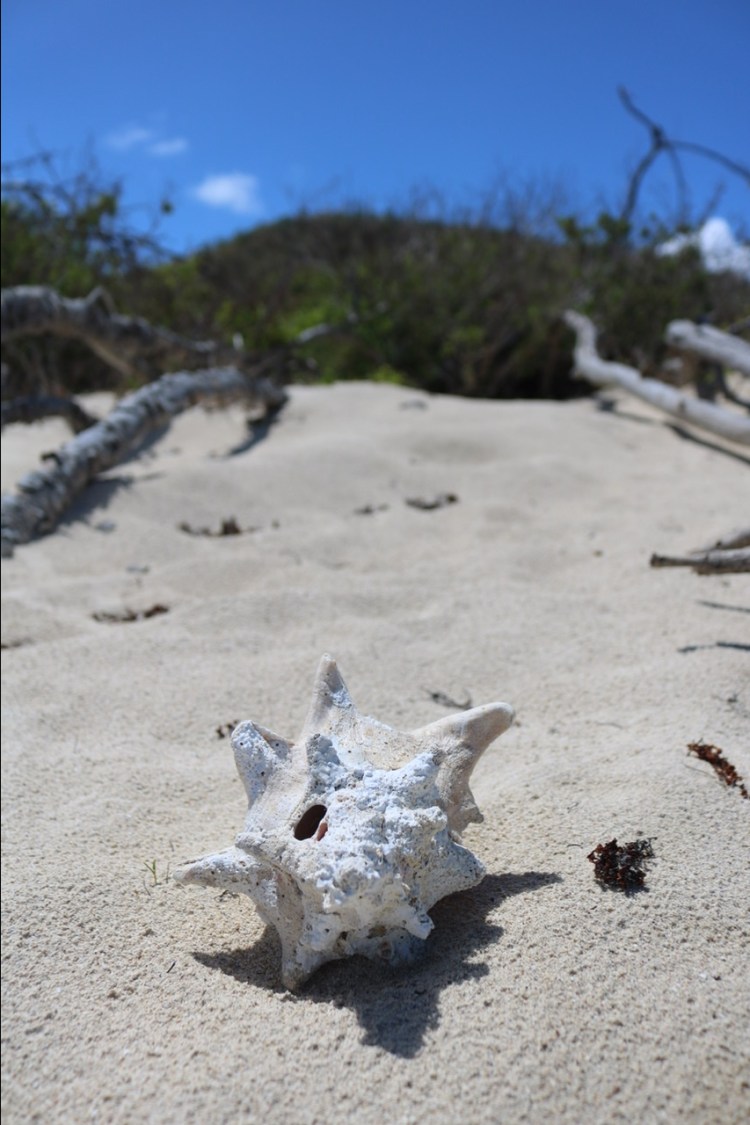
You’ll notice the prominent hole in the crown of the conch shell immediately below, this tells us that the builder of this shell did not die a natural death. When a conch fisherman “catches” a conch (i.e., picks it up off the bottom, generally in 3-20 feet of water), they use a ball peen hammer to make the hole seen below. They then insert a narrow knife (like an oyster knife) and cut the conch’s muscle that attaches the conch’s body to its shell, and the body of the conch slides out.

I also love the pattern of recent raindrops on the sand
Although much further disintegrated, you can still see the hole made by the fisherman

Finally, I got to this section of the beach with innumerable conch shells that were much newer and in better shape. I was reminded of my Uncle Bill who was an avid shell collector. I imagine his little corner of heaven looks something like this.


Take care and stay isolated and healthy. Our little bay was just patrolled by a BVI Immigration boat for the second time in as many days so the BVI government is taking the curfew-lockdown seriously which is a good thing.

In looking back through my journal and ship’s log, I anchored in Little Harbour on March 26th—20 days ago. At the moment, the curfew is to be lifted this coming Monday (April 20th). We just got a tentative announcement from the BVI government that between April 20th and June 2nd residents and guests will be able to move about the country only for essentials. Given that, I’m going to look into sailing for home soon after the 20th. I need to do some limited reprovisioning and wait for a good weather window but those things shouldn’t take more than a week.

Funny, the BVI government announced this news on Facebook. Their post ends:

Medical hotline remains in place. Anyone with cough and fever, or difficulty breathing, asked to call. Only 5 people reported to remain in mandatory quarantine here. Total ventilator ICU bed capability in BVI: 9 – Wash your &$%#ing hands.

It’s funny that up until the pandemic I was having an expected-adventure. While everything was great, nothing was too far from plan or what I expected. Since the pandemic and lockdowns, I and my harbormates have been thrown into unexpected-adventure. One thing I’ve discovered is that being anchored in one place for such a long time with minimal interaction is a very Henry David Thoreau and Walden-like experience. In addition, perhaps the mere concept of expected-adventure, is—itself—an oxymoron.

Hazel James out.

Mysteries, Sea Glass and Irrational Fears

Green Turtle on the bottom in 14 feet of water
(taken from Hazel James’ deck)

One foot in and one foot back,
It don’t pay to live like that.
So I cut the ties and jump the tracks,
For never to return….

Three words that became hard to say,
I and love and you.

—The Avett Brothers, I And Love And You

I played bass in a rock and pop band for a couple years in college. One girl and three guys—we had a blast. After several fast songs, one of us would step up to the mic and in a low, gravely voice say the well-known phrase, “We’re gonna slow it down a little here”. I feel like that now: After several light, somewhat humorous and visual posts, “We’re gonna slow it down a little.”

In mid-2016 as the seriousness of addiction and associated behavioral health challenges were becoming evident, I started keeping a journal. Previously I had toyed with journaling and found it helpful but never stuck with it more than a month or two. However, our lives and our family were in such a state in mid-2016 that I found myself relying on, and looking forward to, my quiet half-hour in the morning when I could organize my thoughts and tell my journal anything and everything. I’ve kept journaling, 4-6 mornings per week the past four years.

On the voyage, I brought my half-completed fourth journal book with me. I left books 1-3 at home in Pompano Beach for safekeeping. Book four is now full and like books 1-3, it has longhand entries front-and-back on each of its 160 pages. When Colleen died on August 21, 2019, book three was three-quarters full. However, I also needed a place to keep track of the innumerable to-dos and details that surround death—especially an untimely and out-of-hospital death, so I cracked open my then-empty book four and used it.

On Thursday September 26th, 2019, a month after Colleen died, I made my final entry on the last pages of book three and moved my journaling to book four. I started journaling on page 10 or so given the opening pages of the book were all death and funeral notes. Looking back, it’s interesting to see my thought process around the death-details unfold. It’s a lot of lists of people I needed to notify and things I needed to do, notes with the Broward County Sheriff’s Office and Medical Examiner, and notes about finding a church hall for her service.

My first journal entry in book four begins…
Friday, September 27th, 2019: Good time to be starting journal 4. I’m pretty much caught-up with miscellaneous stuff around the house and in a position to focus on HJ for a bit. It’s exciting/scary to think that in 3 months I could be headed to the Caribbean.

In the journal entry I go on to describe a phone call I had the night before with a friend in North Florida. Several years ago her husband died a tragic and untimely death. She offered me a key insight on the call. At that time many, many people were telling me what I should do. While all were well-intentioned, those offering advice had never been in my situation. This dear friend—having lived through the out-of-time death of a spouse—came at it from a different perspective. She suggested what I shouldn’t do. Her advice in a nutshell: Don’t try to apply logic to what happened. She went on to say, “I know you and you’re like me in that you are logical and analytical. You’ll naturally want to replay everything that led up to Colleen’s death over and over and over again and look for the pattern, look for the logic.” She concluded that if I try to apply logic and look for, “The answers”, I’ll drive myself crazy. Such helpful advice and the timing of its delivery was exquisite.

A couple weeks ago, when I started the hjsailing playlist, my friend JJ turned-me-onto the Iris DeMent song “Let the Mystery Be”. Listening to that tune over and over took me back to my other friend’s advice to not look for the logic. From the chorus of the song:

Everybody is wondering what and where they they all came from,
Everybody is worryin’ ’bout where they’re gonna go when the whole thing’s done.
But no one knows for certain, and so it’s all the same to me,
I think I’ll just let the mystery be.

While the concept of letting the mystery be is easy to understand from an intellectual perspective, for me it’s been very hard to fully grasp at the emotional level. After seven months, 1,400 miles of sailing and 90 days living on a boat, I think I’m starting to get it.

If there’s any silver-lining to Colleen’s death, it’s that it allows me to get past the recency-bias that I had developed. If you’re not familiar with the term, recency bias is a well-studied and documented phenomenon that occurs when a person more prominently recalls and emphasizes recent events and observations than those further in the past. For instance, when presented with identical symptoms, physicians tend to diagnose illnesses that they have recently encountered.

In Colleen’s and my last several years together, so much time and effort was focused on survival, safety and self-preservation—for all of us. So much so that I temporarily forgot much of the absolutely beautiful life we shared together earlier in our marriage and what a wonderful partner and mother she was. My recency bias had me focusing on the cycles of treatment and relapse and the role of my co-addiction on our mutual well-being, and blocking the more-distant past. When I think about the intensity of what I was experiencing, I can’t imagine what was going through Colleen’s mind. With the benefit of seven months, I’m finding it easier to take a farsighted view of our time together and look past the recent years and consider the full arc of our time together. Addiction was part of her but in no way defines her—she was, and always will be, so much more.

On beach walks in the Virgin Islands, I’ve been finding sea glass, where bottles discarded into the ocean break and the shards are tumbled in the beach surf. The combination of water, sand, movement and time smooths the sharp edges and transforms the shard’s surface from transparent to translucent. Lake Chautauqua, where Colleen and I met, is only 15 miles from Lake Erie. Several times per summer we’d bike or drive to Lake Erie to see sunsets, walk on the beach and collect sea glass.

Sea glass I’ve found on this voyage

The frosted surface of the sea glass gives it a wonderful silky feel. The other day, as I was turning pieces of sea glass in the palm of my hand, it occurred to me that there’s a simile between them and what I’m trying to achieve on this voyage. Setting out from my backyard on January 18th of this year, the memories of Colleen were clear and transparent, and while there were so many good and loving ones, there were a lot of sharp edges from recent memories. Like holding a shard of freshly broken glass, I spent a lot of time with the sharp edges and they would cut and I would bleed. With the benefit of time, sailing on the ocean, salt and sand, and meeting new friends who have no idea of my past—my memories of Colleen are slowly but magically transforming from shards to sea glass. The sharp edges are being worn away, and the specifics are being replaced with the frosted glow of our overall love for each other.

I’ve found this blog to be surprisingly liberating, to, “Put it all out there”, for anyone who cares to read. It’s funny because I’ve had a couple instances recently where a reader will comment, directly to me or indirectly to someone else, “I don’t know you as well as others and I feel like I’m stalking. I shouldn’t be reading such personal information.” While I appreciate your candor, please read-on, and I’ll go you one-further: Feel free to share this with others who may benefit. I know what I’m doing and after losing my sister Amy and wife Colleen, I think I’ve finally figured out that life is fleeting and if there’s good that can come from sharing the story—for the storyteller or listener, or both—why not put it out there? It does no good unsaid.

In the spirit of “putting it all out there”, I do have an irrational fear that has grown as the blog has grown. The fear is this: If Colleen were to come back from the dead today, I think she would read all the nice and loving things and comment, “That’s all well-and-good Dan, but why didn’t you say those things to me when I was alive?”

I think back and in so many ways there was so much more traditional love expressed in our marriage in the first 20 years than in the last 10, and particularly the last 5. We certainly tried but, in looking back with the benefit of 7 months of perspective, a lot of our relationship was in survival mode. However, I deliberately used the term “traditional love” earlier in this paragraph, perhaps just sticking by and not leaving a partner who is in a downward spiral of addiction is one of the greatest acts of love.

In saying this, I’m not casting judgment on anyone who needed or needs to exit a relationship with an addicted partner. Each situation is different with its own unique set of dynamics. Also, I offer this not looking for affirmation and comments back about what I great husband and partner I was, etc., etc. I’m at peace with my actions during a very difficult time in our lives and our relationship. In listening to the song I And Love And You by The Avett Brothers on my voyage, I was so struck by the lines:

Three words that became hard to say,
I and love and you.

While I had heard them many times before, I had never applied them to Colleen’s and my relationship and how hard we both tried in our last 5 years. We did have some successes that can never be taken away and I take solace from that. Still, in many ways, I find it easier to express how I feel and felt about her after she’s gone.

The Moving Finger writes; and, having writ,
Moves on: nor all your Piety nor Wit
Shall lure it back to cancel half a Line,
Nor all your tears wash out a word of it.

—The Rubaiyat of Omar Khayyam
(translated from its original Persian by Edward FitzGerald)


I’ll add both the Avett Brothers’ “I and Love and You” and two versions of “Let the Mystery Be” to the hjsailing playlist. One version is Iris DeMent’s original and the other a wonderful 10,000 Maniacs/Natalie Merchant and David Byrne live duet.


PS: While our little bay is idyllic, we’re all going a bit stir-crazy after 18 days of lockdown-curfew with 7 days to go (we won’t even mention a potential extension). As example, Lancelot and Gautier just had to get a different perspective on the world…

…too bad I missed the shot of them jumping off into the water…next time.