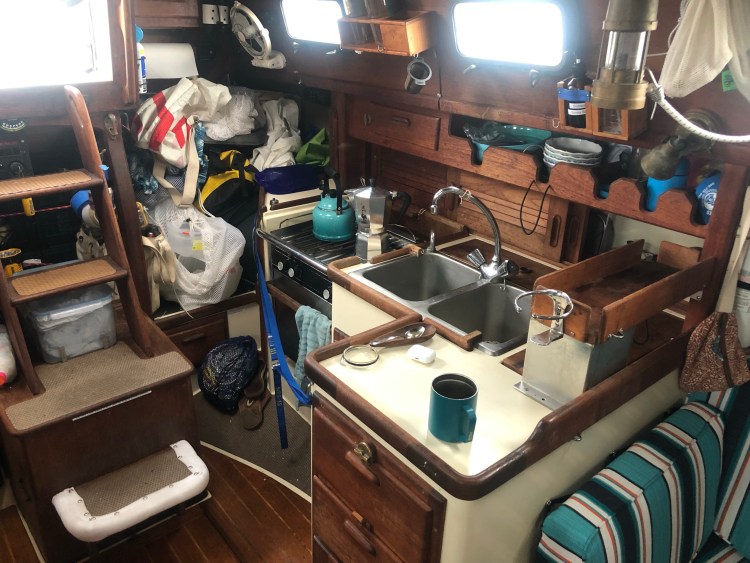
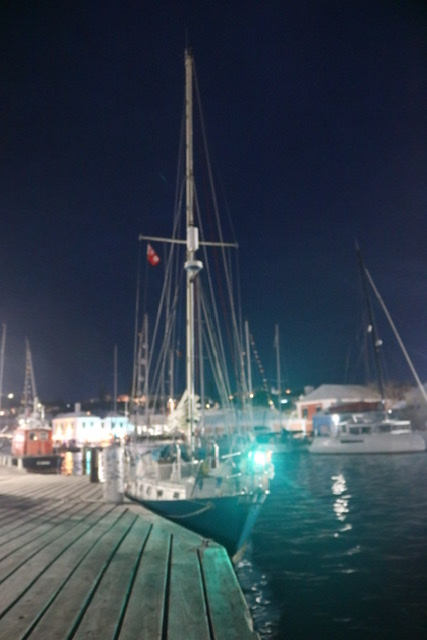
So High School

It’s the evening before Hazel and I are to depart on 18 days of sailing, give or take. I’m sitting in the saloon on her starboard setee with the dining table pulled out and typing out this post. There’s very little movement of the wind and water in St. George’s Harbour—hopefully, midday tomorrow we should begin getting the north wind to start our eastward sail
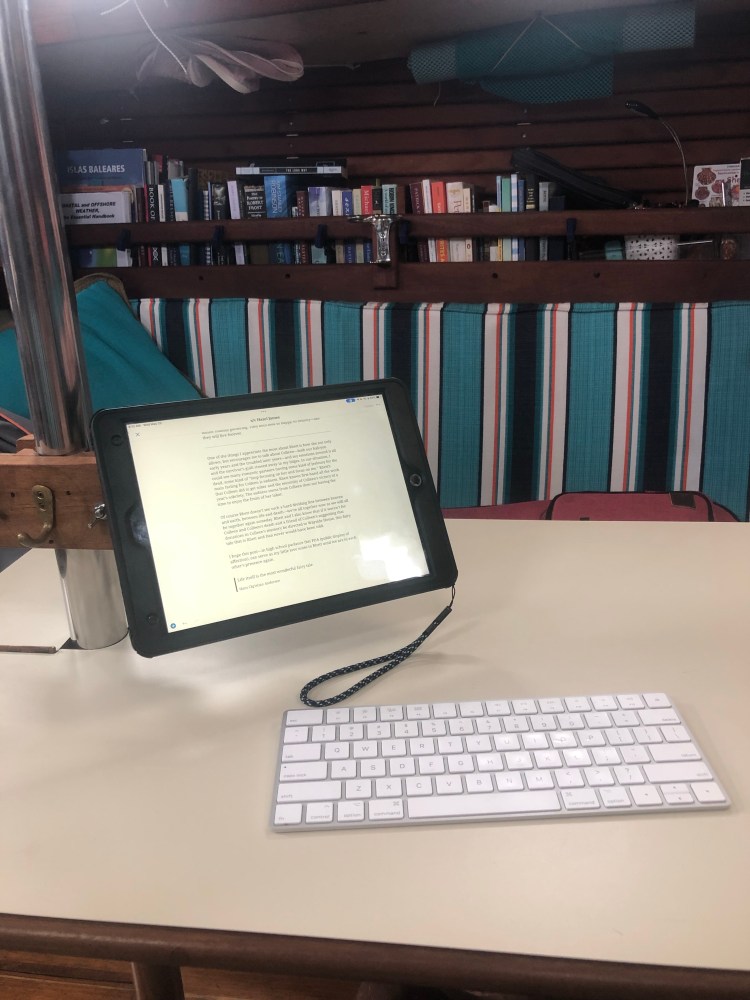
Writing in the saloon.

Lil’ Dinghy is pulled up on deck, her two halves nested and she’s covered with her canvas. All Hazel’s working sails are uncovered and her steering wheel is remounted on the binnacle. I spent three or four hours this afternoon readying for sail. It’s always meditative to do so before a long passage. As I lash and secure, I wonder when and where I will be unlashing and unsecuring—hopefully this time in Horta.

Lil’ Dinghy on deck in her cradles and lashed down fore-‘n-aft and athwartships (side to side). Bow-half is rotated 180° and nested in stern-half. Note mainsail cover is still on and the boom is swung to port out over the water.
Here’s a look at the boom (with sail cover on) swung over the water. The main sheet block and tackle (pulleys) hanging down are used to haul Lil’ Dinghy’s 80 pounds up to deck level.

Hazel knows it’s coming. She reminds me of Gretel and Silvie, our Weimaraner hunting dogs when I was growing up. My father, brother, and I hunted with them and they knew—when the season changed, when the days shortened, when the mornings became crisp—that it was time. The two of them would whine anxiously the night before as we packed the brown Buick station wagon with hunting clothes, trail lunches, and shotguns and shells. On this still night in this protected harbor, roughly a third of the way across the Atlantic, Hazel knows that tomorrow she will be doing what she was born to do—I can hear her whining anxiously.
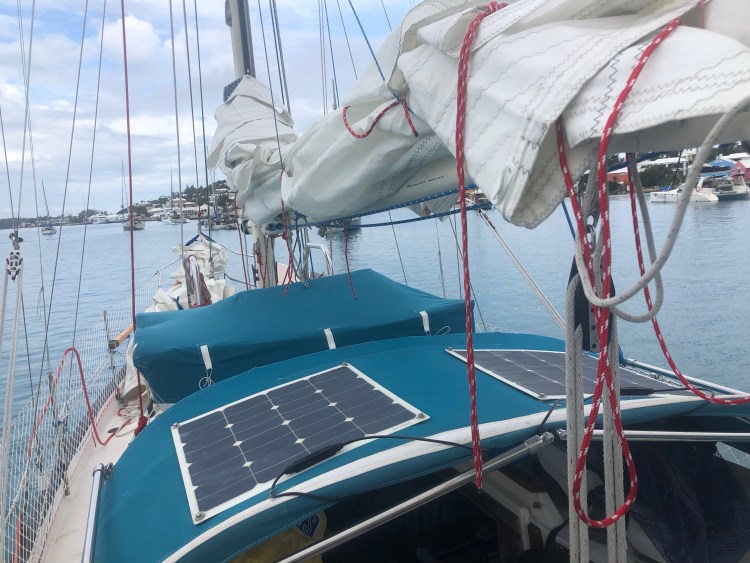
Lil’ Dinghy covered and sail covers off.
Wheel remounted on the binnacle and PFD/harness (personal flotation device) at the ready. Mainsheet block and tackle back in place and ready for sailing.

In many ways, she’s a lucky old girl of 32, our dogs were only given 15 years. All it would take is one or two owners not taking care of her, not using her, and soon she’d be neglected in some boatyard and eventually scrapped for parts. It hurts me to even think of that scenario.

Joshua [the name of Bernard Moitessier’s boat] gathers way and begins to come alive…People who to not know that a sailboat is a living creature will never understand anything about boats and the sea.

Bernard Moitessier, The Long Way

While there are a lot of things that I’m not so good at, I like to think that one thing I’m pretty good at is knowing when to challenge authority and fight back, and when to just accept what is and follow instructions.

I think the situation I’m at the moment demands first the latter, then the former.

I’ve been told that I need to write a subtle blog post that addresses the delicate subject of Rhett’s and my relationship—simple enough on the post itself, I can do that.

The reason I need to write it is because people are talking (since Rhett and I aren’t sailing together): Is there a disturbance in The Force? Trouble in paradise?

As to the subtlety required, I was further told that, at the end of blog post, a reader should get the message without ever realizing that the message was delivered. Hmmmmmm.

After mulling the challenge over for weeks, I’ve concluded that the subtly would require some literary sleight of hand that I don’t possess. Therefore, I need to default to the former and throw the subtlety over the proverbial transom.


On the morning after my first night of sailing to Bermuda I brewed myself some coffee. During the process I pulled out one of our metal coffee mugs and was just about to pour some boiling water into it to pre-heat it for the coffee. Just before pouring a splash of steaming water into the mug, I noticed that there was a small envelope in it. It was purple pastel and about three inches wide and two inches tall. Odd, I thought, What would that be doing in there? As I pulled the envelope out of the mug, I noticed that it had a small heart sticker on it, I started to put two and two together and suspected it was from Rhett. I opened the envelope and found a simple, stiff white card with rounded corners—no design, no fold, no sappy mass-produced “Hallmark” poem, just Rhetts cursive handwriting and a heartfelt message of encouragement.

Since finding that first note, I’ve found about 20 other similar cards and notes that Rhett had surreptitiously stashed throughout Hazel. Rhett knows my routines on the boat and her strategy was for me not to find them all at once, but over time throughout the voyage. It got to the point on my sail to Bermuda that when I was having a good day and stumbled upon a note, I consciously overlook it, not touch it and let it be. I knew that soon enough I’d be having a bad day and need to “find” it.

There are still a couple that I know of left unopened, I saving them as dry powder for the next 1,800 miles.

After I’d found 5 or 10 notes, the cynical side of me—did I tell you that I have a cynical side…or did you just pick that up yourself?—tried to say, Leaving love notes? Get serious—that is so high school. Then surprisingly, I was rescued by the logical side of me. Yes—I said the logical side—the poetic justice is that it’s the logical side that typically gets me into trouble when it comes to matters of the heart.

“Logic” volleyed back to “Cynical:” Now you get serious! How can you claim that receiving love notes is, “So high school?” What kind of revisionist history are you peddling? I’m “Logic” and I know that in high school we never received little love missives from a cheerleader…let alone any girl.


The side panels of Hazel’s saloon (around the portlights) are oiled teak and the ceiling is a vinyl headliner, similar to a 1980s car. Where the two meet circumscribes the saloon at eye level. Early on, I discovered that “boat cards” and photographs can be inserted into the seam between the wood and the vinyl and they generally stay there (after some rough weather, there are always one or two on the saloon sole). Cruisers often have “boat cards” with their vessels name and contact information, it’s a handy way to stay in touch. When I was single-handing in the “BR” days (before Rhett), I had gotten into the habit of keeping the cards I received end to end around the saloon. In the AR epoch, Rhett enthusiastically joined in the tradition and by now the starboard side of the saloon is filled with boat cards and we’re starting on the port side. It’s fun to look at a specific card from time to time and reminisce when and where we met a crew.

Starboard-side saloon boat cards.
Port-side with boat cards in foreground and Rhett’s notes in the background.

Naturally, when I found that first card from Rhett, i inserted it in the starboard-side seam. Now, with the volume of Rhett’s notes on Hazel’s and my Florida to Bermuda passage, I’ve almost filled the port side with them.

While they are oh so sweet and give me just the boost I need, when I need it—the only problem is that they also bring a twinge of guilt. Why didn’t I think of something similar to do for her before I departed Florida?

Interspersed with the cards are a few photographs. The first photograph to occupy the seam between vinyl and wood is of Colleen and my sister Amy. They were fast friends and this picture is from some winter holiday gathering. They both look so happy, so healthy—like they will live forever.


One of the things I appreciate the most about Rhett is how she not only allows, but encourages me to talk about Colleen—both our halcyon early years and the troubled later years—and my emotions around it all and the survivor’s guilt stowed away in my bilges. In our situation, I could see many romantic partners having some kind of jealousy for the dead, some kind of “Stop focusing on her and focus on me.” Rhett’s main feeling for Colleen is sadness. Rhett knows first-hand all the work that Colleen did to get sober and the enormity of Colleen’s victory of a year’s sobriety. The sadness stems from Colleen then not having the time to enjoy the fruits of her labor.

Of course Rhett doesn’t see such a hard dividing line between heaven and earth, between life and death—we’re all together now as we will all be together again someday. Rhett and I also know that if it weren’t for Colleen and Colleen’s death and a friend of Colleen’s suggesting that donations in Colleen’s memory be directed to Wayside House, this fairy tale that is Rhett and Dan never would have been told.

I hope this post—in high school parlance this PDA (public display of affection), can serve as my little love notes to Rhett until we are in each other’s presence again.

Life itself is the most wonderful fairy tale.

Hans Christian Andersen

Bermuda Shorts

My time in Bermuda is coming to a close. In talking to my weather router on the high frequency radio and looking at the forecasts myself, I’ll likely be departing tomorrow (Wednesday, May 25), a day earlier than reported previously. Flexibility is key in this game.

I’ve throughly enjoyed my stay in Bermuda. The islands are striking and full of history, the people are gracious and always helpful. Here are some vignettes to give you a flavor.


A Farewell to Arms

On the evening of Saturday, May 14 when I entered St. George’s Harbour and disembarked at the customs and immigration dock. The officer asked me if I had anything to declare. I said that I had a flare gun. It’s a small plastic pistol that shoots phosphorus parachute flares and is “no big deal” standard safety equipment in offshore boats. However, in Bermuda not only are flare guns treated as lethal weapons, so are spear guns and Hawaiian slings (both used for spear fishing). Bringing them into the country is expressly prohibited. All are “bonded” upon entry (taken by the officer and logged, and returned to the master of the vessel when departing).

Therefore, on my exit tomorrow, in addition to minor paperwork with customs and immigration, I’ll get my flare gun and eight “rounds” (flares) returned to me.

This juxtaposition with the US’s perspective on “real” guns (where there are more guns than people in the US) was striking. Particularly when the first US news story I read when I got some internet access was the horrific racist shooting in the Tops Supermarket in Buffalo (Colleen’s home town).

The Gibraltar of the West

Gibraltar, at the entrance to the Mediterranean from the Atlantic is still a British territory and, especially during the colonial period, was intensely fortified. During that time, Bermuda was nicknamed The Gibraltar of the West. Perhaps the reason Bermudian forts were never fired upon is because they were so impressive.

Also the closely linked islands of Bermuda have a natural protection of reefs that I had never realized before visiting.

Good satellite image of Bermuda and surrounding reefs. Major shipwrecks are indicated by red dots. For reference, the islands themselves (not including the reefs are 21 miles from northeast to southwest).

In the map above, Hazel and I are in St. George’s Harbour in the northeastern end of the islands. The British Royal Navy base was located in The Dockyard area to the southwest. Given the shallow reefs, the only approach to The Dockyard is shown by a red line (freighters, ferries, and large cruise ships still use that channel). Therefore, along the St. George’s area and northern end of the island, a series impressive forts would have made mincemeat of any foreign warship that attempted to approach The Dockyard.

Fort St. Catherine’s at the northeastern tip of Bermuda stands out as the most impressive installation. The museum there had a fascinating history of heavy armaments from muzzle loading, smooth bore cannons, to rifled muzzle loaders, to rifled breech loaders. Now it’s surrounded by luxury hotels and a golf course (sigh).
A large cruise ship at The Dockyard today.

Interestingly, St. George’s Harbour used to be the up-and-coming cruise ship destination. However, as cruise ships got larger the Town Cut into St. George’s Harbour could no longer accommodate them so the large cruise ships diverted to The Dockyard leaving St. George’s as more of a private yacht and smaller cruise ship destination (in this definition, “yacht” would include Hazel James and similarly sized private vessels).

“Small” cruise ship off Hazel’s port beam entering St. George’s Harbour (Hazel is lying to anchor).

What’s in a Name?

What I call a white-tailed tropic bird, my favorite species of bird, the locals refer to as Bermudian long-tail (it’s on their quarter coin). They are all over the islands of Bermuda in the spring and were nesting in crevasses in the fort walls around The Dockyard. I just can’t get enough of them and am curious how far east I will see them as we make our way to the Azores.

Bermudian long-tail (a.k.a., long-tailed tropic bird). Fort wall to the left.
I find the undulations of wings and tail feathers hypnotic.
Coming in hot! A long-tail approaches it’s crevasse nest.
A little closer on the approach. It’s hard to imagine the aeronautics necessary to stop a pelagic seabird in mid-flight to land gently on a vertical surface.
Clinging to the fort wall and feeding it’s young. The adult never went in the nest. I imagine because the young had grown so large, the parent could no longer fit inside with them.

Not all Fun and Games

I read once in a smiling book that a circumnavigation is nothing but a series of boat projects in exotic destinations.

While I made some outright and many preemptive repairs on Hazel in St. George’s Harbour, the most photogenic was the up the mast work.

Hazel is outfitted with mast steps that fold out from the mast and I also use a “bosun’s chair” (climbing harness as a safety back up).

The main job up the mast was to replace a hard shackle with a soft shackle on the spinnaker halyard block at the top of the mast. On my way up and down, I carefully examined all other fittings for chafe or signs of wear.

Preparing to climb, the bosun’s chair.
“No time like the present.” Looking up the mast. I’ve already been up once so the the fold-out climbing steps are deployed.
From the top looking down. Note Lil’ Dinghy streaming off Hazel’s stern.
New soft shackle in place between the “bail” above and the hard shackle below. Before the hard shackle connected directly to the bail and when the spinnaker would shift, it made a god-awful banging noise. This should quiet things down. Note the anemometer wind vane and cups above. These lead down to an electronic instrument in Hazel’s cockpit that show wind speed and direction.

Interestingly, if you look up the term “white knuckle” in the dictionary, you’ll see the above picture.

Close up.
Good view of Hazel’s 470 watts of rated solar panels. 2, 50 watt panels on the dodger (middle of picture). 2, 110 watt and 1, 150 panels on the solar arch at the bottom of the picture.
View of a nearby shipwreck from the masthead.
View of the town of St. George’s from the masthead. The large boat in the middle of the picture, named The Blue Peter, is a wooden yacht built in 1930!
Another sailor up the mast of his boat. It doesn’t look like this boat is outfitted with mast steps so the sailor was probably cranked to the top by a crew member on a winch. The steps on the mast help with a single-handlers self sufficiency.

“We Could All be Speaking Spanish”

At the Fort St. Catherine’s museum, the docent told me an amazing story.

In the early 1600s, just a few years after the British had established themselves in Bermuda (by accidental shipwreck in a hurricane coincidentally), their defenses were still weak and developing.

To their dismay, sentries at a newly established fort on the islands spotted two Spanish men-o-war (warships) approaching. Unbeknownst to the Spanish, the British fort had all of three cannonballs and limited gunpowder. Not wanting to engage, the British artillery put a warning shot across the bow of the lead warship. However, the Spanish kept coming. The British artillery managed to then put their second shot through one of the Spanish ship’s sails, certainly sending a message but doing no real damage. However in the excitement of reloading the soldiers knocked over their remaining gunpowder and it spilled on the ground. They had nothing left.

On the lead Spanish warship, the captain considered the situation and the fort and decided that continuing to sail at Bermuda would be suicide. The men-o-war bore off and sailed away.

The docent concluded the story, “If that captain would have made a different decision, we could all be speaking Spanish today.”

The Gunpowder Plot

In the US Revolutionary War, the Continental Congress forbade US trade with loyal British Colonies. This put the midatlantic Bermuda in a bind since it had become dependent on goods and food from the US colonies. Long-story-short, 100 barrels of gunpowder were smuggled out of British forts in Bermuda and transported to the colonies in exchange for food and other goods. That gunpowder was critical to the Revolutionary War’s outcome. Details below…

Blockade Running

While the British were officially neutral in the US Civil War, sentiments in Bermuda leaned to the Confederacy. Somewhat because of the trade from the US south’s cotton to British textile mills and somewhat because of cultural similarities (Yankees were viewed as uncouth), somewhat because of…you guessed it…money.

There were fortunes to be made in blockade running. Wilmington, NC was the closest Confederate port to Bermuda and large, slow British sailing merchant ships would offload cargo in Bermuda. The Confederate-bound cargo of gunpowder and munitions would be transferred to small, fast but often unseaworthy steamships designed to run the Union blockades.

The success-to-loss ratio chart over time shows how effective the blockade runners were in the beginning of the war but how fortunes changed as the Union tightened its grip on Southern ports.

More details…


As you might tell, I’ve been enthralled with the history of Bermuda. However, as my weather window opens, Hazel James and I have got to say goodbye with a final load of laundry and some last-minute provisioning today.

After those trips, I’ll haul Lil’ Dinghy up on Hazel’s deck and prepare to sail tomorrow. I’ll also try to make a last blog post tomorrow morning.

I anticipate about 18 days of sailing to Horta, Azores and am hoping that Rhett will be there soon after for us to continue to Spain, mainland Portugal, or Gibraltar together!

I’ll try to make daily updates on the satellite tracker while I am sailing. Tomorrow I expect a north wind so will start sailing east on a port tack (wind coming across the left side of Hazel). The wind should veer to the southeast and south on late-Thursday or Friday and I will then tack to starboard and head north a bit before turning east again…at least that’s the the plan.

Fair winds and following seas!

Quick Update from Bermuda

An upper level TROF is favored to persist near the Azores with RIDGING along or offshore the E US through June 1. The TROF near the Azores supports a few low pressure systems which essentially act as a roadblock for Trades N of about 20N or 25N. The RIDGING off the E US prevents significant systems from exiting the E US and funneling trades across the Atlantic.

Chris Parker, Marine Weather Center, May 21, 2022

All is well in Bermuda but, per the above advice, we’re not going anywhere for the next couple days. The synoptic forecast paints the picture that we have a “roadblock” for the westerly trade winds that we need to blow us east to the Azores.

Most likely, Hazel and I will depart this Thursday, May 26, sail north for a day or so on an easterly breeze and then arc eastward as the wind veers from the east to south and southwest. We’ll hope to arrive in Horta, Azores around June 12th.

More to follow. I’ll plan to get some posts and Bermudian updates out in the next couple days and then switch over to satellite posts once sailing.

Fair winds!

Hazel James lying to anchor in St. George’s Harbour

A Thousand More Words

Sailing is a long lesson in patience.

Bernard Moitessier, The Long Way

While Lil’ Dinghy is launched and I’m anxious to get on land in Bermuda and see the islands, and also get some things done (provisions on/garbage off, propane, a good restaurant meal, couple new lines and fittings, etc.), this morning’s weather is conspiring against me with spitting rain and overcast skies. Oh well, the weak cold front is to pass today and tomorrow’s weather should be fine for shore activities.

With a little time on my hands and an hour or two of internet access left on a 24-hour plan, I thought I’d give a little pictorial tour of HJ’s interior as a refresher. Do keep it mind that it’s just me on her so she’s in a bit of “bachelor mode.”

If you’ve ever seen the movie Master and Commander based on the Patrick O’Brien novel of the same name, it has an accurate portrayal of most everything on a boat having more than one purpose (depending upon conditions and what’s needed from her). I like the scenes in the movie where the officers are having a spirited dinner in the captain’s quarters, and then when fired upon by their French nemesis, the captain’s quarters are cleared, table stowed and the area is converted to an aft gun deck. There are parallels on Hazel.

View down the companionway into the saloon. Galley to port, head and navigation station (nav station) to starboard, forepeak berth (V-berth) forward.
View the other way out the companionway. The “bridge deck” is the area in the foreground, tucked under the dodger and a good place to wedge yourself when conditions are snotty. The blue cover is over the binnacle where the steering wheel is mounted. Note that steering wheel has been removed and is in the background to the right, stowed on the taffrail (gives more space in the cockpit when at anchor).
The view up the companionway steps. “Ox” our diesel auxiliary engine is under the hatch (get it? Ox and “Aux.”). Note white shin bumper around the bottom step. That’s a new add for us after having our shins beat up for weeks. Note that top two steps are a removable ladder.
Top two steps removed and hatch raised, exposing Ox.
Close up of Ox for all you diesel-heads. He’s original. 1990 Yanmar 3GM30F with 4,100 hours on him. I’ve been making more of an effort to keep him clean and painted. It’s a lot easier to quickly spot problems on a clean engine.
Head in middle, companionway steps to the right, nav station to the left.
View of nav station, electrical panel above nav station, iPad mounted above that, and electronics to the left. Note blue strap below to strap yourself in at sea. Also note red lights to preserve night vision.
Close up of electronics. Clockwise from upper left: iPhone, chartplotter (GPS), RADAR, high frequency radio (aka, single sideband radio), VHF (very high frequency radio) tuned to the 16 international hailing frequency, AIS (automatic information system).
As an aside, the high frequency (HF) radio which has a range of thousands of miles needs a long antenna to transmit and receive the longer wavelengths it uses. Therefore the backstay of Hazel is insulated from the rest of the boat and used as its antenna. Note wire from transom being led up the uninsulated bottom, of the backstay. At the top of the picture just above the solar panels is the antenna insulator and wire connection to the backstay. There’s an identical insulator at the top of the backstay.
Back below, the nav station from another angle.
Nav station raised, revealing refrigerator.
Close up of fridge.
Galley. Note similar blue strap for cooking in a seaway. Note that propane stove is on gimbals so it can stay level while Hazel heels.
Another view of galley.
Fun shot from sailing of the stove at an angle.
Watermaker is in bottom locker. Note watermaker gauges to the right.
Watermaker pressure gauge and flow meter.
Locker opened.
Close up of watermaker.
Port setee (couch) that doubles as “pilot berth” (a place to sleep at sea).
Setee in pilot berth mode with lee cloth raised to keep the sleeping sailor from falling out and cushion at top of photo removed to expose footwell to stretch out.

Worth 1,000 Words

I fully believe in both, in the poetry and in the dissection.

Ralph Waldo Emerson, “The Naturalist,” 1834

If a picture is truly worth 1,000 words then this post will roughly equal the 85,000-word Heeling is Healing in value. Given my internet/satellite connectivity situation, allow me present a whole series pictures from our Ft. Lauderdale to Bermuda passage in this post—call it “the dissection.” Via satellite tracker I’ll catch up with the missives (the “poetry”).

Hazel departing Cooley’s Landing Marina
Approaching the Ft. Lauderdale SE 17th St Bridge in the Intracoastal Waterway (no fear, we have about 5’ of clearance).
Sailing!
US Navy sub seen soon after.
My son Jack’s commercial swordfishing vessel The General approaching the evening of day 1.
The General closing in.
The General alongside. Fishing buoys line her decks.
I’m feelin’ good.
Iconic shot taken by friend Bryan.
The General heading out to the swordfishing grounds.
Freighter taking our stern several days later.
Nice sunset (trusty EPIRB [Emergency Position Indicating Radio Beacon] in upper right).
Freighter off our beam that eventually passed in front of us. When I saw it, it wasn’t transmitting AIS…yikes! There’s a story behind that encounter—and a valuable lesson.
Glorious sunrise.
White-tailed tropic bird close to Hazel (it’s worth zooming in to see just how beautiful a bird this is).

The white-tailed tropic bird is my favorite species. I first saw them on my passage from The Bahamas to the Virgin Islands and I wrote about them in this post.

If you look carefully, flock of five white-tailed tropic birds that circled us for hours.
If you look very carefully…Land Ho!
Q flag (yellow square quarantine flag) flying in Hazel’s rigging as we approach Bermuda.
Entering Town Cut, St. George’s Harbour.
That evening, Hazel sitting peacefully at Her Majesty’s Customs and Immigration dock after clearing in to the country. Note Bermudian courtesy flag I just raised in her rigging. The bright green light at her bow is her starboard-side running light.
Full moonrise in St. George’s Harbour (wreck in the foreground).
Bermudian houses off Hazel’s stern while we are at anchor. The distinctive clinker style roofs are designed to catch and harvest every drop of rainwater. There’s a good lesson for South Florida in that. Experts say that South Florida will run out of freshwater long before it is inundated by seawater.
View from Hazel at anchor toward the town of St. George.

With the exception of a half hour at customs and immigration, I haven’t been ashore yet. I’ve focused my initial time here on resting, sleeping and tiding up Hazel. I plan to launch Lil’ Dinghy this afternoon and get ashore for a stroll and a dinner.

And finally, thanks to all of you for reading and following along. As I’ve been able to tell a few friends and family, making daily satellite posts was very helpful to my emotional state. Just knowing that loved ones were there and listening helped me keep it all in perspective.

Departing in the Next 30 Hours

Destiny deals the cards, but we play them.

Solo circumnavigator Bernard Moitessier, The Long Way

Good morning! I’ll keep this quick…

All indications are that Hazel and I will be departing Cooley’s Landing Marina in Ft. Lauderdale sometime tomorrow.

Getting from the marina to the ocean is a little tricky given that New River is narrow and tidal with relatively strong currents (its normal downstream flow reverses on the flooding tide), and that there are three drawbridges across it between Hazel and the Intracoastal Waterway. In addition, the three bridges do not open during rush hours (7:30 to 9:00 a.m. and 4:30 to 6:00 p.m.). The ideal times for a boat like Hazel to transit the river are at slack high (around high tide) which occurs twice per day, and the second best option is slack low (2-3 hours after low tide). At any other time, the river is flowing (downstream on the ebbing tide, and upstream on the flooding tide) which makes passage either arduous (motoring against a couple knots of current) or “exciting”—trying to wait for bridge’s opening in a narrow and crowded river with the current pushing the low power and single-engine Hazel into the bridge (high power, multi engine boats with bow thrusters, etc. have a lot easier time when the current is flowing). Bottom line, I’ve got only a couple options to get out tomorrow and I’ll need to pick my time carefully. To the good, this will be my sixth transit of the New River so it’s getting to be old hat for me.

I got a clean COVID test yesterday and have emailed it to the Bermudian health authorities in advance of my departure. Also, late yesterday evening I got a return call from “my weather guy” Chris Parker (everyone has a weather guy—right?).

While I had thought that tomorrow looked pretty good for a departure on rumb line to Bermuda (a more-or-less straight line), a strong low pressure system that will exit the US Atlantic seaboard over the Chesapeake Bay on Sunday had been giving me some pause. Chris confirmed that Thursday was a good departure date from what he is seeing but advised me to stay further south than I had been planning, to avoid the gale force winds that the low pressure system will generate. I’ll likely start the voyage by sailing the Bahamian Northwest and Northeast Providence Channels (keeping the Little Bahama Bank to the north and the Great Bahama Bank to the south). Early next week and as the low passes, I’ll arc northward toward Bermuda—at least that’s the plan.

I’ve got to get going for now as today will be full of last minute, fresh food provisioning and other minor things to take care of (and resting and relaxing as much as possible).

I’ll try to make updates to my satellite tracker as I am able on the passage (posted on this site’s home page).

Fair winds and following seas. Hazel James out.

Refreshed hjsailing.blog Home Page

Good morning! After getting some feedback from blog followers and thinking about the number of satellite posts that I hope to be making to my PredictWind satellite tracker during my transatlantic attempt, I put my nose to the grindstone and figured out how to embed the satellite tracker into the hjsailing home page.

Please check it out, bookmark it, and—when I start the transatlantic attempt—check frequently for updates. It’s pretty cool if I may say so.

Full internet access is required to make regular blog posts, complete with pictures, email notifications, etc. (this post you are reading is a “regular” blog post). However, when I’m sailing without full internet access, the best I can do is make “micro posts” via a satellite connection to the satellite tracker. Unfortunately, email notifications are not available when I make micro posts via satellite.

For those interested in the technical details, Iridium is the satellite connectivity service I use and PredictWind is one of the weather forecasting services I use and it overlays Iridium. PredictWind also provides the satellite tracker (thus its logo on the tracker).

Navigating the Tracker

Given that navigation is important, regardless of whether sailing the ocean or surfing the web, here are some tips for navigating the embedded tracker in the refreshed home page (it’s not complex but it’s a little different than on the native tracker page):

  • Double tap on the tracker to zoom in.
  • Pinch with two fingers to zoom back out.
  • Use two fingers to move or pan across the map.
  • The lower left of the tracking window shows when the last satellite update was made, and Hazel’s latitude and longitude position, and speed at last update (I think satellite updates are made hourly, I know it’s not real-time).
  • The white boxes in the lower center and lower right of the tracker show the couple most recent satellite micro posts. Scroll to the right to see older posts.

As I say on the home page, please remember that satellites are not foolproof and I generally shut down the tracker when I’m in port for more than a few days. Bottom line, don’t freak out if Hazel James appears to ”disappear.” If I do find myself in an emergency situation, I have other communications channels that I will be using.

Also as I say on the home page, if the embed breaks or otherwise gets funky, you can always go to the native PredictWind page for HJ to see updates.


I have a few last minute items to take care of and, otherwise, am waiting for a good weather window to embark. Hopefully within the next week you’ll start seeing the beautiful arc of Hazel’s and my track across the Gulf Stream (between mainland South Florida and The Bahamas), over the Little Bahama Bank and leaving the islands of Grand Bahama the Abacos to starboard and bound for Bermuda!

Intended course to navigate around The Bahamas and bound for Bermuda.

Fair winds and following seas.

Announcing the Release of “Heeling is Healing”

While I’m happy and proud to have gotten to this point with the project, I couldn’t have done it without the support and encouragement of all of you. Thank you.

Although I haven’t yet received substantive interest from publishers or agents, there’s magic in momentum and I have that magic now, and I want to put a full stop on this sentence of my life and get back out on the ocean. While I was initially disappointed (and angry) about the lack of response from professionals, my emotions were tempered when I walked into a dusty used bookstore with shelves packed from floor to ceiling. As I inhaled and smelled paper—paper that had spent just a little too much time in Florida humidity—it struck me that, behind every volume, there was an author and I’m confident that that many of those authors had traversed the same valley of despair as I in the process of getting their work distributed. The sheer volume of books available retail and online is astounding. While Heeling is Healing means a lot to me, and I hope it will to you too, it’s a literal (or, should I say, “a literary”) drop in the ocean.

Getting rejected by an agent.

While that trip to the local bookstore quelled my disappointment, it also left me feeling insignificant. At that point, I did the logical thing and started feeling sorry for myself. That sorry-for-myself mood lasted for a couple weeks as I was concurrently preparing Hazel James for our transatlantic attempt. Then, serendipitously I stumbled upon an old journal entry of mine from the morning after attending a lecture by the astrophysicist Neil deGrasse Tyson. In the talk, Dr. Tyson admitted that he used to feel insignificant when he looked up at the night sky. His admission caught my attention because I too felt insignificant under the celestial dome. While I’m no astrophysicist, I know enough about space, deep time, and distances measured in light years, to realize how small any of us are in the grand scheme. However, Dr. Tyson went on to share that he was working on reframing his feeling of insignificance, to a feeling of connection. When stargazing he visualizes the atomic particles in his body as what they are: the product of the Big Bang. As he said so eloquently, “We are all stardust.” In that same way I’m trying to reframe my struggling-author feelings from insignificance to connection. Connection to a vast pantheon of writers—some well known, some as of yet unknown, some who will never be known.

Trying to concentrate.

With that preamble, here’s the deal: the release of Heeling is Healing is all-electronic and the manuscript can be downloaded from this web page in a couple different and convenient formats. While someday I will get Heeling is Healing into a printed and bound format with appropriate artwork, that day is not today.

From the financial perspective I ask that when you download a copy of Heeling is Healing you donate a minimum of $20 to Wayside House (home page here to learn more, direct link to donation page here). For those of you who have been following our hjsailing.blog from the beginning, you’ll recognize Wayside House as both the women’s addiction treatment center where I had asked that donations in Colleen’s memory to be directed, and the organization where Rhett served as Chief Development Officer. It’s a wonderful not-for-profit organization that provides services regardless of a client’s ability to pay. In addition, Wayside House is woven into the warp and woof of Heeling is Healing.

…but wait—there’s more! For every dollar that you donate, I will personally donate a matching dollar, up to a total of $10,000 in donations. What you say? Is this shameless self-promotion by Dan to “boost sales?” Has the frugal-but-borderline-crazy-Dan that I know finally lost it and rowing his boat with only one oar in the water? Time will tell on all of this.

If you enjoy Heeling is Healing and want to pass your copy on to others, feel free to do so. Just link them back to this site and ask them to make a donation. Also, if you know people in the traditional publishing and literary agency world that may want to work with me to create the physical incarnation of Heeling is Heeling, please forward the work to them gratis and I’d be happy to talk to them.

While I had many great editors along the way (and they are thanked in Heeling is Healing’s Acknowledgements), I have to say that one of my editors was a real wiener.

The Download and Donation Details

First of all, I’ve tested the downloads and formats as well as possible but there’s a limit on what I can do prior to making this post public. If you find problems or have suggestions to make the book more accessible, let me know and I’ll do my best to incorporate good suggestions.

There are two download formats available (PDF and Microsoft Word) to support any of three reading methods (printed, Kindle, Apple Books):

  1. Physical Printing – If you want to go old school and physically print the book on 8.5×11 paper, download the PDF version below. It will take about 100 sheets of paper double-sided. The big office supply and shipping stores offer self-serve black & white printing for about five cents per printed page—that works out to about ten bucks to print. All pages are numbered so binding is optional.
  2. Amazon Kindle – With the industry standard Kindle reader and app, you can read Heeling is Healing from most any device. Kindle also nicely handles the resizing of text for your device’s form factor (it’s physical screen size) and adjusts line wraps accordingly. After a bit of testing myself, I’ve found that the Microsoft Word file works best on the Kindle. While Kindle can also handle PDFs, I find that the PDF file’s formatting is clunky and confusing (e.g., table of contents looks awful, no page break between chapters, etc.). Bottom line, I recommend the Microsoft Word file for Kindle reading.

    If you’re used to emailing yourself files to read on your Kindle, you can stop reading now as this will be old hat. If not, read on—I’ll provide a brief overview of the process with links to Amazon’s detailed instructions.

    A lot of Kindle users don’t realize that, in addition to Kindle-format downloads from Amazon, a Kindle device or app can receive and process a file emailed to it. When you get a Kindle reader or download the Kindle app to a phone or tablet, that reader/app is assigned a unique email address in the format [prefix]@kindle.com. As stated previously, this functionality is easy to miss and consequently a lot of people don’t know their Kindle reader/app’s email address. In addition, to prevent spam being sent to your Kindle, it will only accept emails from your “approved contacts.” The detailed Amazon instructions here explain how to find your Kindle email address and also how to make your day-to-day regular email address an approved contact so it can send files to your Kindle reader/app.

    One important note (and why I used “singular/plural” above) is that if you have multiple Kindle readers/apps, each will have it’s own unique address. The upshot is that you’ll have to email the Heeling is Healing file to every device on which you will want to read it. The good news is that Kindle does a nice job syncing your last-page-read across devices and apps so you can pick up where you left off regardless of the device you’re using.
  3. Apple Books – A great option if you have an iPad and especially if you use Apple Books for other reading (a.k.a., “Books”). I’ve found that the PDF is best for Books. The PDF file is formatted for 8.5×11″ paper and I find it easily readable on my 10.5″ iPad. Reading via PDF allows you to see the chapter headers on each page which helps with intra-book navigation.

    To load onto Apple Books, download the PDF version of Heeling is Healing, navigate to where you saved it and open it via the free Adobe PDF Reader software (probably already on your iPad). Once the file is opened in the PDF software, a “share” button should be in the upper right corner of the screen (a small blue square with an up arrow). Click on the share button and select Apple Books (it’s an orange icon of a book and is titled “Books”)*. After a short pause, Heeling is Healing should be uploaded to Books and the Books app should start.

    * In testing this, the one wonky thing I’ve found is that the Apple Books app seems to appear in different places on different devices. If you don’t immediately see it after you click the “share” button, look in the third row from the top in the “share” window (the row that starts with AirDrop, Messages [text], and Mail [email]). Swipe to the right and you may see Books in that row. If not, click on the “More” button (an ellipsis icon) furthest to the right in that row and scroll down and you should see Books as an option.

I’m sure there are other formats and reading apps available for the tech savvy. If you’re looking for an audio book version, alas you’re out of luck at the moment. That would be a fun project when I have some land-time and don’t have a transatlantic sail looming.

Please note that the Microsoft Word file is password protected. When you see that warning box, just click the button to open the file read only.

Final editing this spring in The Bahamas

And now for the part to really feel good about…the donation to Wayside House.

Please click here to make your minimum $20 donation. On the donation page, please select the Colleen Coate Memorial Fund to help us with dollar-for-dollar match accounting. I’ll report on our progress in future blog posts.


While the above process has a few more steps than just going to an e-commerce site, clicking a button and getting the book delivered the next day, please be patient and remember that this approach allows us to support the mission of Wayside House with absolutely zero overhead, and thus maximizes our collective assistance to women who are facing similar challenges to Colleen’s .

To understand the power of our approach, consider the fact that only 5-20% of the price of a traditionally published finds it way back to the author. Doing the math…let’s say I were to receive the midpoint of that 5-20% and Heeling is Healing sold for $20 as a traditional book. I’d get $2.60 per book and I’d have to pay income tax on that and then I could donate the meager remainder to Wayside. Instead—with our approach—when you make the $20 donation and I match it, Wayside receives $40… about 20-times what they might get from me via a traditional approach. The answer is obvious and just as obvious, is that $20 is a minimum—the more you give, the more I give, and the more Wayside wins. As an added kicker, Wayside is a 501(c)(3) not-for-profit so your donation is tax deductible.

If there are two things that our crazy, mixed up, modern world could use, it’s less overhead and more honor system and—together—that’s exactly what we’re doing.


I look forward to your feedback on the book. Again, I appreciate everyone’s support in getting the project to this point—I can’t thank you enough. Fair winds and following seas!

Hazel James in Duck Harbor, Isle Au Haut, Maine this summer.

The Death of Each Day’s Life

I’m on my back and my field of vision is framed by Hazel James’s bow hatch. It occurs to me that I’m actually seeing (as opposed to dreaming that I’m seeing). As my eyelids close and reopen in a soft but long blink, I feel the slight crust of sleep around my lashes. My hands instinctively feel around the bedding next to me…nothing…nobody—as in (literally) no body…I’m alone. In this delicate, temporal, and interstitial place between sleep and wakefulness I wonder if I will remember what it was that I had been dreaming about. Sometimes I remember and sometimes I don’t. I suppose it doesn’t really matter though because, even if I initially remember what I had been dreaming about, those memories quickly fade as I regain wakefulness. They fade like a Maine oceanic fog burned off by the morning sun.

Although I shouldn’t be, I’m confused by what I see out the bow hatch. I don’t know why I’m confused because I’ve been seeing he same thing for a month. Still…it gets me every time. I don’t see the floats of clouds illuminated by the moon, or the stars—or maybe both—as I would when we’re voyaging. I see what appears to be a flat whiteish haze. It’s not a haze though, it’s the underside of a four-sided, pyramid shaped umbrella that I rigged over the hatch. It shades the midday sun and also keeps misting rain and light rain showers from waking us up in the middle of the night. While torrential and wind-driven rain finds a way around the umbrella, in the subtropics much of the rain is brief and benign. Usually, when we are anchored overnight, or for a few nights when voyaging, I don’t bother to rig the umbrella. Somewhat because it’s a pain to rig, somewhat because I (or we) want to fall asleep to the clouds, moon, and stars. The upside of the celestial view far outweighs the downside risk of being awoken in the middle of the night to a face full of rain and a mad scramble to get the hatch shut.

Hazel James waiting patiently for her upcoming shakedown sails prior to departing. Open down hatch with umbrella suspended over it. Also note the white safety netting attached to her deck and lifelines, that’s new in preparation for the transatlantic sail.

This gauzy line of thinking reminds me of a moonless night in Maine when I wasn’t alone in the berth. Rhett and I were lying side by side—my arm cradling her neck. We were stargazing through the hatch as we were drifting off to sleep. It was a magical moment and we stopped talking and honored the moment of perfection with silence. We had been marveling at the stars that comprise the Summer Triangle: Altair, Vega, and Deneb. The subject of our conversation had been that we weren’t really seeing the stars, we were seeing the way they looked in the not-so-distant and distant past: Altair as it looked 17 years ago (at a distance of 17 light years), Vega as it looked 25 years ago, and Deneb at a whopping 1,400 years—the light were were seeing was generated in 622 A.D.

As we were appreciating this subject—this subject that was far bigger than our day to day triumphs and travails, bigger than the political whims of autocrats, bigger than another mass shooting—a meteor shot across the narrow field of vision of our bow hatch. As with Fourth of July fireworks, in unison we instinctively and sharply inhaled and then quickly exhaled with an, “Ahhh!” Then we slept.


Imperceptibly, the level of consciousness rises in my brain. I know it’s happening but it’s happening gradually. The same way that we know that sea levels are rising but we can’t see the change on a day to day basis. I feel the bedding next to me just to make sure. Yup, still empty. I remember that I’m by myself—single-handed as it were. Land-based living is full of commitments and deadlines and distractions, and Rhett has hers and I have mine.

While part of me is scared to sail again on the open ocean, another part of me yearns for the single-minded focus it requires, yearns for the self-reliance that it exacts from the soul, years to be free of these terrestrial deadlines and distractions.

What was it that woke me?

Oh yeah, It’s what generally wakes a 57-year old man in the middle of the night. I’ve got to pee.

I groggily climb up Hazel’s companionway into the cockpit and swing myself onto her side deck and slide my feet into well-worn flip flops. As I shuffle down the dock’s splintering planks to the marina’s bathroom facilities, I do my best to not restart my brain. If I can just relieve myself and get back into bed before and I start thinking too deeply about anything, perhaps I can get back to sleep.

Bottom-line, I’m not successful. Halfway to the bathroom, I’m conscious enough to remember that I plan to embark in a week or two. In a fortnight I hope to be sailing to the northeast, toward Bermuda and the Azores and the Mediterranean. My mind starts clicking through the boat projects I need to complete, the provisioning I need to do, the additional spares I need to buy and store onboard. The spares are in the event of a “known unknown” happening—in the grand scheme, they are the easy things to deal with. As I consider the prospect of 3,800 nautical miles of open ocean sailing punctuated by a couple archipelagos, it’s the “unknown unknowns” that give me pause. I wonder if I’ll really have the guts to go? echoes in my waking brain.

Back in Hazel’s saloon, I look at my digital watch that I keep next to my berth. It’s 2:30 a.m. Too early to get up for the day. I need to get my mind cooled down so that I can get back to sleep. If there’s anything I need in this lead-up to my departure, it’s sleep—and lots of it. Fortunately I happen to be in the midst of reading the Illiad by Homer. It’s the perfect balm to break the cycle of rumination and get me back to sleep. My version of Homer’s epic poem is 400 pages and I’m finding that it’s like kale. I want to like it but I’m not sure if I do, but I know it’s good for me. After several pages of Zeus, Helen of Troy, Achilles, and Odysseus, and dreaming of sailing the waters that they sailed, I start seeing double as my tired eyes lose focus. I reread the same paragraph multiple times and still have no idea what I read. At that point, I figure its time to climb back in the berth and continue to knit up my raveled sleeve of care.

Sleep that knits up the ravell’d sleave of care,

The death of each day’s life, sore labour’s bath,

Balm of hurt minds, great nature’s second course,

Chief nourisher in life’s feast.

William Shakespeare, Macbeth

The Ambivalence of “Left or Right?”

Yikes! From a writing perspective, I’m seeing that we’re a quarter of the way into 2022 and I’ve only done two hjsailing posts for this year—way off my pace of other years. However (and in my defense), while Rhett, Sunny, Hazel James, and I were on our Bahamian voyage earlier this year I was relatively prolific with micro-blog posts (I count 15 for the year on the PredictWind satellite tracker). Since I can compose and upload them via satellite, I can do them from anywhere and that’s freeing to me because we blissfully chose to not have daily internet access while in The Bahamas. Also in my defense, my work on the Heeling is Healing manuscript has continued (the nature of the work has shifted, but the work continues)…more on that later in this post.

Currently, Hazel is comfortably moored in Cooley’s Landing Marina on the New River in Fort Lauderdale. It’s a municipal marina with a broad spectrum of boats in all states of repair and disrepair. Those boats are occupied (and sometimes not occupied) by a broad spectrum of mariners and dreamers of all skill levels. For added entertainment, Hazel’s slip is next to one of the marina’s several public ramps used by day-boaters trailering their small craft. The weekends are a constant stream of families and fisherman dunking and retrieving their rides. From observation, I’ve learned that on the way into the water, sometimes the outboard starts, and sometimes it doesn’t. At the other end of the voyage—on the way out of the water, sometimes the captain remembers to tilt the outboard up prior to pulling the boat and trailer up the boat ramp, and sometimes he is reminded to do so by the sound of the engine’s skeg raking along the boat ramp. With all that being said, the marina is perfect for me with a bath and laundry facility as I’m living aboard Hazel. Rhett and Rear Admiral Sunny split their time between the marina and Rhett’s house in Delray Beach (25 statute miles north) where Rhett is attending to some land-based things. In addition, the yachting district of Fort Lauderdale is a 10 minute drive from the marina. It’s a section of town that occupies several blocks and has most any marine service a sailor could want.

Port Everglades, Fort Lauderdale, Cooley’s Landing Marina, and Hazel
Hazel in her slip. If you look carefully, you’ll see Lil’ Dinghy in pieces on Hazel’s deck (I’m doing some work on Lil’ Dinghy as well). Small-boat ramp in the background.
Another view of Hazel with the morning sun behind her. The towels hung on the life lines give her that ever-so-perfect Beverly Hillbillies look when juxtaposed with the big power yachts in the background. All I need now is Granny on deck in a rocking chair.

We checked Hazel into the marina on March 16 and paid upfront for a month of transient dockage (about $1,600 if anyone is curious). We got lucky finding a slip here because, as far as I can tell, the majority of boats that occupy the 30 or so slips in the marina are long-timers. Hey—if you’ve got a boat, given the price of housing in South Florida, I’m sure it’s cheaper to live on the boat at the marina than rent an apartment or try to buy a house in this crazy-inflated housing market. Consequently, the whole vibe of the place almost…just almost…inspired me to get a P.I. license and hang out my shingle (“P.I.” as in Private Investigator). I grew up watching 1970s television and all I learned from all those hours of sitting too close to our black & white in the basement was that in order to be a legit PI you had to live on a boat, or in a mobile home, or some similarly sketchy situation—to wit: James Rockford, Joe Mannix, Peter Columbo, Frank Cannon, and Shaggy, Scooby and the gang. Alas though—the only two cases that I’m really interested in solving at the moment are: how do we get everything done on The Mystery Machine (i.e., Hazel) in the next couple weeks and—once we’re done with our projects—do we go left or do we go right?

The ambivalence of my feelings about the left or right decision is driving me a bit nuts, but I’m trying to embrace the positive aspects of it. As I say this, I’m reminded of my visits to my therapist shortly after Colleen’s death. I had started seeing my therapist a several years before (when we were in the trough of addiction) and I had found her questions to me and her reframing of situations most helpful. With that said, I hadn’t seen her in the year immediately prior to Colleen’s death. However, one of the first things I did after being interviewed by the police and medical examiner was to get on my therapist’s calendar as I knew I’d need help piecing my life back together. Several sessions later, my therapist asked the question, “With a little distance between you and Colleen’s death, how are you feeling about it all?” I sheepishly replied that I felt ambivalent—it sounded so terrible to hear myself say that word. When she asked me to expand on my thoughts, I began by saying how much I missed Colleen, how sad I was that although Colleen had worked to hard to achieve the year of sobriety immediately before her death, she didn’t have the chance to enjoy the fruits of her labor—I added the remorse I was feeling about how I could have been a better partner, and how my last goodbye to her was not under the best circumstances. I then went on to confess that—on the other hand—I didn’t miss the chaos around the house that addiction brings, I didn’t miss the unknown about what “Colleen” I would find when I came through the front door. I also said that Colleen had become terribly fearful of aging and that while her demise was horrible, at least she wouldn’t have to go through the inevitable process of the living. I initially felt like such a bad person for sharing those feelings, and sharing them so soon after her death. However, after hearing me out, my therapist reframed my mixed emotions to help me see the positive of them. Yes, it was bad—very bad—what had happened. However, it wasn’t all bad. By combing through the smoldering rubble of my life at the time, I could find a few things to feel good about.

Similarly, I’m trying my best to see the positives of my current ambivalence about the left or right decision that will need to be made in a couple weeks. To the left (or “to port” for the aficionado of nautical parlance) lies Bermuda, The Azores, and Spain or Portugal, and the Mediterranean. To the right (that is, south) lies the Caribbean. As earlier reported, I was (and am still) contemplating a transatlantic sail (the left turn out of the Port Everglades inlet), however the tragic and terrible invasion of Ukraine has given me some pause. I’d rather not be in the middle of the North Atlantic, halfway between Bermuda and The Azores, and hear that the war has spilled into my intended destination of Western Europe. A second option we are now considering is to depart around the same time (late-April or early-May) but instead sail south, deep into the Caribbean or South America, with the goal of getting south of the hurricane belt prior to the June start of the Atlantic hurricane season. Either way, and the same as our most recent Bahamian voyage, I’ll most likely start the sailing single-handed with Rhett and Sunny joining later.

Regardless of the decision, I know myself well enough to know that I need to go somewhere and go soon. A couple weekends ago my family gathered in Pittsburgh to celebrate the wedding of my eldest nephew Ben to his now-wife Sara. While it was a perfect wedding, punctuated by dancing late into the night, it was hard to be there and hard to see it without thinking about the absence of my sister Amy and of Colleen—they both would have loved the affair. During the reception, as my melancholy thoughts drifted to the future, I couldn’t help envisioning my kids’ upcoming weddings. I’m sure those days will be similar bittersweet cocktails of joy and sadness. Through it all, I remain obsessed with the brevity of life and voyaging while I can.

I try to journal on most mornings and each journal entry begins with the day, date, and time of the entry. During our voyage last summer up the US East Coast, I started adding the latitude and longitude of the journal entry. As I journal in these quiet mornings at Cooley’s Landing Marina and my pen writes the coordinates of 26-07, 080-09 (twenty-six degrees and seven minutes north, and eighty degrees and nine minutes west), I’m reminded that I’m not physically moving. Still, I tell myself that the physical voyage across the face of the earth is just that: the physical voyage. Even through I’m in one place for a month or so, my emotions are still voyaging, still surfing the crests and riding the troughs of my thoughts and moods. It’s all part of the same voyage.


From the Heeling is Healing perspective, in December 2021 and January 2022 I had worked the manuscript into good-enough shape to begin sharing it, and also developed a five-page manuscript proposal that outlined the book’s “elevator pitch,” how the work came to be, its target audience, a comparison to well-known books, and an author’s bio. I wrote what I thought was an engaging proposal and sent it out to 20-30 agents and publishers. The one best word to describe the response is… “crickets.” The taciturn agents and publishers didn’t reply at all, the loquacious ones send me a “Dear John” form letter (and then signed me up for their mailing lists).

Originally, I was kind of down about the situation. However, and most-fortunately, when I was in the midst of the thundering chorus of crickets, I happened to be reading Ahab’s Rolling Sea—A Natural History of Moby-Dick by Richard King (I highly recommend it by the way). In the early chapters, King describes Melville’s struggle with writing what he wanted to write versus having his name on a book that would sell. King writes, “…Melville was thirty-one years old, overwrought with debt, and now a father to young children. He assessed himself as a failure as a writer. He’d moved out of the city [New York City] to try to raise corn and potatoes on a small farm as he tried to complete Moby-Dick. He wrote to [Nathaniel] Hawthorne: ‘What I feel most moved to write, that is banned,—it will not pay. Yet, altogether, write the other way I cannot. So the product is a final hash, and all my books are botches.'”

Perhaps I’m in good company.

Also, I remind myself daily about how therapeutic the writing process has been for me and—agent or no agent, and publisher or no publisher—the process of telling myself the story of how my sister’s and my wife’s demises have indelibly changed me, is something that I will always have.

In the midst of the pandemic and leading up to the Jewish high-holidays, I had heard an interview with a rabbi about what his message to his congregation would be. The rabbi said that the most important thing he had learned in rabbinical school was to, “…give the sermon that you need to hear.” That’s what makes it authentic. Heeling is Healing is the sermon that I needed to hear (and I still have a lot of hope it can help others).

With that in mind—and similar to the navigational question of left or right—with the manuscript I feel like I’ve sailed it far offshore, have encountered some mechanical issues, and now need to bring it home safely. When I embarked, I had a clear plan: write, edit, get a publisher or agent, then publish the work—just that simple. Now, with no land in sight (and no agent or publisher in sight) I need to alter my plans, I need to improvise, I need to get it done—somehow. When sailing in this situation, the question isn’t, “if I get back to land”—it’s “how I get back to land.” The question on Heeling is Healing isn’t if I publish, but rather how I publish.

Also, when the chips are down on a long passage, it’s always comforting for me to think about the support that I have back home and from others. With Heeling is Healing I also know that all of you who are kind enough to follow my writing and are interested in reading the story its long format.

Bottom-line and with your support, I will publish it. I have an idea of how to do it and also how to do some financial good with its publishing as well. More on that in my next post. In the meantime, I’ll leave you with the 30-second elevator pitch from the manuscript proposal:

Heeling is Healing is a modern-day hero’s journey, precipitated by the deaths of my sister from cancer and my wife from mental illness and addiction. Its themes—of love and loss, of charting a new course forward in my life, and of rediscovering romance—are set against the backdrops of a challenging 2,500-mile single-handed sailing voyage and the global pandemic. Heeling is Healing has multiple goals: to tell the painful story of substance abuse and addiction, and the powerful, relentless grip of this disease on relationships and on family; to offer a hopeful path forward to those who are grieving loss, from any cause; and to educate and entertain readers about the rigors and splendor of long-distance solo sailing and voyaging (the nautical term “Heeling” describes a sailboat’s leaning due to the pressure of wind on its sails).

Fair winds and following seas!