Happy times in front of a prehistoric megalith on Menorca in the Islas Baleares
Perhaps you’re thinking that this post will be a shameless promotion of our book Heeling is Healing (available now at a finer blog site near you!)—but it’s not. This post’s title is an honest question that I’ve been wrestling with lately: is heeling (sailing), really healing (good for me, good for Rhett, good for our relationship)? While I’m sure that sailing was my savior when I was single-handed soon after Colleen’s death and I was in the Caribbean in spring of 2020, I’m less confident about it now.
Clearly, some of my questioning of what I thought was a fundamental principle in my life is driven by the challenges of Mediterranean sailing; something I didn’t fully appreciate before leaving Gibraltar in our stern wake. Like most Americans, when I imagined “sailing the Med,” my mind’s eye saw nothing but blue water, blue skies, and steady 10-15 breezes blowing in any direction I wished.
In retrospect, this spring back in Florida—as I was prepping Hazel for the voyage and reading Homer’s Iliad and Odyssey—I should have suspected that my idyllic daydreams of Mediterranean sailing were just that. While the Iliad’s subject is the 10-year Trojan War (fought on plains surrounding Troy), the Odyssey is all about Odysseus, King of Ithaca, and his protracted 10-year journey home from the Trojan War (as an aside, our English word “odyssey” comes from King Odysseus, something I never figured out until I read the epic poem!). As I became engrossed in the tale, I mapped the location of ancient Troy (now in Western Turkey) and the island of Ithaca (in the Ionian Sea between mainland Greece and Italy) and estimated the distance between the two at about 400 nautical miles. It was easy for me to then conclude that Odysseus must not have been much of a sailor. Granted he had no diesel engine (like Hazel’s “Ox”) that he could fall back on when the wind died, he had no geosynchronous orbiting satellites and GPS system and electronic chartplotter—but still…10 years to make 400 miles? Give me a break. He must have royally offended Poseidon to have 10-years of obstacles thrown into his path of what should have been a leisurely week’s sail. That was my naive thinking this spring from the Western Hemisphere. I never knew how good I had it on my first single-handed odyssey in the Caribbean just months after Colleen’s death, where trade winds blow true and honest and are predictable day after day after day. Now that Rhett and I are firmly ensconced in the Mediterranean Sea and starting to get a feel for its weather patterns, Odysseus taking 10 years to cover 400 miles doesn’t seem so unreasonable.
As an example, on our last passage, 235 nm from Menorca (in the Spanish Baleares Islands) to the Italian island of Sardinia, our conditions ranged from a beautiful sailing wind (both in strength and direction), to no wind, to a light wind on the nose, to gale force winds with gusts of 45 knots in a blinding thunderstorm—and this was all in the same day.
However, in this post I’m less concerned about the number of miles we cover, our average speed, our days on passage and all those numbers and metrics, and more concerned with the emotional stability of Hazel James’ captain. Sailing with others is a difficult thing for him in the finest of weather—then, when the winds are fickle and ever changing, or blowing like a banshee and the seas are steep and confused (as we’re seeing most every passage), look out! He can be a holy terror—he’ll even go so far as to start talking about himself in the third-person.
Although I know myself well enough to know I can be this way, what really bothers me is my lack of progress with “getting better.” That is, being less demanding of myself and others when we sail, not manufacturing crises just so I can look like the hero when I solve them, and other transgressions I’d rather not disclose.
A little over a year ago (who’s counting…but I’ll tell you it was on Saturday, September 19, 2021 at 8:15 a.m.), I wrote in my journal that the day before Rhett told me, “My sweet Dan leaves when we sail.” While her comment was anything but funny, it mirrored good humor (it’s funny because it’s true). We were sailing in Long Island Sound from Montauk Point to New York City and the day before I had not been my best self. Her comment was so accurate about me, so dead on, that I wrote about it in my journal, thought about it endlessly, meditated on it—and still here we are. I feel like Odysseus; Poseidon throws obstacles in front of me (he has home field advantage here in the Med) and I lose my temper.
In doing some quick calculations from Hazel’s Ship’s Log, I’ve sailed over 7,000 nautical miles since Rhett made that comment a year ago, that’s a lot of physical progress over the earth’s surface. However—emotionally—it feels like I’m sitting in the same bathtub drinking the same bathwater. I start to question how I’ve structured my recent life around sailing and voyaging, and—by extension—how Rhett has graciously structured hers, and how we are building a future life together. I love sailing, but what if it brings out the worst in me? What then?
A sailing season is like life, neither lasts forever. If there’s anything I should have learned in my 58 years on earth, it’s that. A couple weeks ago, it seemed like we’d be sailing forever this season. However, in our time here in Sardinia, Rhett and I have taken a hard look at the calendar, noticed the shortening days and intensifying oncoming Mediterranean winter weather, and done our best to figure out our immigration status in the EU and how long we can rightfully remain in the the Schengen Area before we need to exit for a number of months. Long story short our forever-sailing has suddenly morphed into laying-up Hazel within the next couple weeks in mainland Italy for the winter so we can explore Northern Italy, France, and maybe the Netherlands for a month or so before we turn into “Schengen pumpkins.”
Now, all of the sudden, I’m writing this blog post on the eve of what will likely be our last passage of 2022. It should be a 260 nm sail from our current location in Marina di Stintino in northwest Sardinia, through the Strait of Bonifacio (separating Sardinia to the south and Corsican France to the north), to the town of Gaeta on mainland Italy. We have some newfound friends in Gaeta and wintering Hazel there seems safe for her and logical for us. The emotional net-net of all of these machinations is that if I want to show myself, and of course Rhett, some progress in my attitude toward life onboard, I’ve got to do it over the next several days; not some fuzzy future the next several days! The weather forecasts are good, we’ll be sailing east and we should have moderate to fresh southerly breezes to blow us to Gaeta on a beam reach. However, I have some well-founded trepidation given that we’re in the Med. “The captain” does a lot better and is a lot easier to live with in fair winds and following seas (who isn’t?). While the forecasts predict just that, I’ve learned enough about the Med (and the tricks that Poseidon keeps up his kelpy sleeves) to know to not count on the forecasts. That’s the challenge, both getting the boat from here to there and doing it on an even-keel—balancing miles and smiles. As I envision slipping our moorings early tomorrow morning, motoring past the marina’s breakwall with a pre-dawn glow in the east and out into the Golfo dell Asinara, hoisting sails and laying in a course for the Strait of Bonifacio at a range of 50 nm, I think about what captain will show up for the sail and will he talk about himself in the third-person or the first-person? I so want to finish the sailing season on a positive note. Your guess is as good as mine on how it turns out: stay tuned, I’ll update you on the other side.
Well I’m thinking I’m knowing that I gotta be going You know I hate to say ‘so long’ It gives me an ocean of mixed up emotion I’ll have to work it out in a song
John Prine, You Got Gold
Thanks as always for reading and allowing me to work out my little ocean of mixed up emotion with you.
unmoored /ˌənˈmo͝ord/ /ˌənˈmʊrd/ ADJECTIVE 1. (of a vessel) not or no longer attached to a mooring. 2. (of a person) insecure, confused, or lacking contact with reality.
Oh there are so many titles I could have chosen for this post: “Question: How Bad is It? Answer: Uhhhh,” or “The Gale,” or “Swab the Decks,” or “Three Trips Around the Sun,” or “A Positive Crew and a Negative Captain.” At the end of the day, I’m sticking with “Unmoored” as it rolls all the other titles one overarching feeling. Still though, as I look at “Unmoored’s” two dictionary definitions, neither quite does it for me. I’m a person which directs me to the second definition, but my feelings relate more to the first, the vessel, definition. I’m not insure or confused or lacking contact with reality (at least I like to think I’m not) but I feel no longer attached to past physical moorings.
We departed the marina La Linea de la Conception, just north of Gibraltar, in high spirits the morning of Sunday, August 14. One quick stop at the marina’s office and fuel dock to settle up our marina bill and top-off the tanks with 8 gallons of diesel (as an aside, after 4,500 nautical miles of travel [that’s 5,200 land based miles], it was our first refueling since we departed Florida on May 5th—pretty cool!).
Hazel in her marina slip with the Rock of Gibraltar in the background to the south.
As we slipped our moorings in the marina my mind was in the future, already thinking about the sail to the Islas Baleares a semi-autonomous Spanish archipelago located in the Mediterranean Sea, 100-150 nautical miles south of Barcelona. The three largest islands in the archipelago, from west-to-east, are Ibiza, Mallorca, and Menorca.
It was a sunny morning with mild winds. The Rock of Gibraltar was our backdrop as we approached the fuel dock, prepared for a “port-to” tie up (putting the dock on Hazel’s port, or left, side). After maneuvering Hazel James out of the marina slip she had occupied for two weeks, I handed the helm to Rhett (she took over the steering) for the quarter mile slow speed steam through the marina docks and the approach to the fuel dock. As Rhett and Hazel executed their turns perfectly, I silently mulled over if I should just let Rhett take her all the way on to the fuel dock. It would be a first for Rhett, and conditions were perfect for her to keep the helm all the way onto the dock. Besides, I’ve learned that Rhett—with her intuitive style—is better under pressure when she doesn’t have a lot of time to think through things ahead of time.
About 100 feet off the fuel dock and as I was just about to make the surprising “command,” “Rhett, why don’t you bring her in? Don’t worry, I’ll be right next to you the whole way.” I reconsidered. The closer we got to the fuel dock, the more imposing it looked; it wasn’t some friendly and forgiving wooden dock, but was solid concrete and high. Besides we were both a bit rusty as we hadn’t sailed in a fortnight. So I said instead, “Move over, I’ve got this. Go forward on the port side and get ready to get a line around a piling.” In retrospect, I had been so busy considering Rhett’s potential rustiness, I hadn’t given a thought to my own. I really don’t remember what I was thinking—something along the lines of, Easy peasy. Ideal conditions. I’ve done this a million times before.
I settled myself at the helm and took a good look at the rapidly approaching dock and right away knew it wasn’t going to be “easy peasy.” I was in trouble. The wind that I thought was mild was a lot stronger and blowing across our starboard beam thus pushing us towards the monolithic concrete. In addition, I had her moving way too fast through the water. A second later, CRUNCH, and Hazel shuddered to her keel bolts.
Although I couldn’t see it from my vantage point, the point of impact must have been about 10 feet forward of Rhett’s position. Shaken, I hoarsely croaked, “How, bad is it?” Rhett looked over Hazel’s gunnel and replied calmly, “Uhhhhh, let’s get on the dock and you look at it.”—her polite southern way of saying, “It’s bad.”
Now to put this SNAFU (situation-normal-and-fu****-up) into perspective and in context of everything that Hazel and I had been through on this voyage, it’s like driving a large RV out of New York City by yourself and heading west, eventually stopping in Indiana and successfully competing in the Indianapolis 500, then eschewing the Rocky Mountain and Sierra Nevada highways for the narrowest two-lane mountain roads possible, and—finally—backing into a lamp post in a San Francisco Walmart parking lot.
The chainplate I bent on Hazel’s port side and wood knocked out.As comparison, the starboard (undamaged) side and what it SHOULD look like.
I was really worked up by the whole thing. I remember pacing the decks saying over and over, “What just happened? I don’t do things like that!” Eventually, I calmed myself down enough to look at the port side forward chain a plate that I had bent in the allision. After literally pulling at my hair in anguish for a minute, I determined that I could fix it on the spot and we didn’t need to turn back and get the help of a metalworker. Having a new chain plate fabricated would have taken several days to a week.
After fueling up, making the necessary repairs, and profuse apologies to Hazel for my rough treatment of her, we were on our way—three miles south, around Europa Point (the southern tip of Gibraltar) and east into the Mediterranean Sea. Rhett enjoyed the vistas while I continued beating myself up and replaying the morning’s events.
Sailing east with The Rock astern and to the west.
From my pre-departure weather check, I knew to expect a bit of wind in our first couple days of the 400 nautical mile passage to the Baleares Islands—it should peak at 25, or maybe 30 knots, hold for 12 hours or so and then subside. However, as we put Gibraltar astern, I was so absorbed in my self-flagilation I barely noticed that—well ahead of schedule—the wind had built to a solid 20 knots off the stern.
Long story short, that night we experienced sustained winds 35-40 knots and gusting into the low 40s, with seas in the 10-15 foot range—by all definitions, a “gale.” The irony of this is that in my entire Atlantic crossing, I didn’t see winds this strong. Not until Rhett and Sunny join Hazel and me do we get blasted like this…go figure.
Later the next day as as things are calming down and we’re licking our wounds, Rhett confides that she’s not feeling well and she doesn’t think it’s just from the rocking and rolling of the night before. So, a hundred or so miles from land and with our destination of Ibiza at a range of 250 miles, we pull out the COVID tests and instead of the crew swabbing the decks, she’s swabbing her nasal passages. 15 nervous minutes later—drumroll—there’s no line on the test strip, no antigen detected. Whew. During the whole 15 minutes of waiting we did our best to not let our minds race to the what-ifs.
After a couple more days of sailing, we reached the Baleric island of Ibiza and were having an excellent time exploring until it all came crashing down the morning of August 21 (not the first time things have come crashing down on the 21st of August). On the morning of the third anniversary of Colleen’s death we were anchored in a broad “cala” (Spanish for cove) close to Ibiza Town and I was planning for a quiet and reflective “boat day” thinking about Colleen. However, after waking and getting going for the day, Rhett felt just awful—even worse than she felt the day after the gale. Again the COVID tests came out but this time her test kit immediately showed she was positive. She took another test, same result. Ugh, not good. Given her results, I tested and was negative and remained negative throughout her contagious period—unbelievable given the tight quarters we share.
The “R” is for Rhett and “D” for Dan. I still can’t believe I didn’t get it.
it was a rough couple weeks for Rhett. She said it was the sickest she’s ever been in her life. After a couple days of her trying to muscle through the illness on board, we decided she needed the ER and maybe even a hospitalization. After a day in the ER we got her a hotel room for several days so she could recuperate in some air conditioning and with a bed that didn’t move (As another aside…the bill for tests, medications, and care during her four hours in the ER? 138 Euro, under $150).
Since then we’ve sailed from Ibiza to Mallorca, and Mallorca to Menorca (where we are at the moment). Although we’ve seen a lot of the Islas Baleares, it’s amazing how much there is to see here. A sailor could spend an entire summer cruising season on any one of the islands.
The reason I focused on “Unmoored” as the title for this post revolves around our future plans as summer turns to autumn. The good news is that European schools are back in session and the Mediterranean summer crowds are starting to dwindle. The not so good news is that we have lots of logistics and unknowns now looming. In the summer we were focused on getting to and into the Mediterranean; yes, the unknowns and logistics were there but the were “tomorrow’s problems.” Now that we’re here in the Med and summer has passed we’ve got to think about getting to our goal of Greece before colder winter weather arrives, where we layup Hazel for the off season, our immigration status in the EU, what we do in the winter, Hazel’s taxation status, and the list goes on and on.
In addition, Rhett’s COVID diagnosis on the day of Colleen’s death anniversary was especially difficult timing. When I had sailed to the Caribbean solo in 2020 searching for some peace after Colleen’s death the previous August and gotten locked down in the British Virgin Islands for a month or so due to the pandemic, I had a similar unmoored feeling—I was more than a thousand miles from home with so much changing. Several weeks ago, Rhett’s diagnosis, illness, our trip to the ER, and her subsequent recovery on top of Colleen’s anniversary brought back so many memories for me from that time. It’s one thing to be in The Bahamas and having the comfort that home is only a 3-4 day sail away. It’s different to be in the Caribbean and a thousand miles from home or—even more so—to be in the Mediterranean and 5,000 miles from home.
I find myself searching for the positives in my “unmooredness” the way I searched for Portugal and the European mainland on the horizon on the last day of my transatlantic sail. On that final day’s sail, I couldn’t see the land, at least not yet, but I knew it was there. I knew it was close.
In a few hours we will depart the Spanish Islas Baleares and head east bound for the Strait of Bonifacio that separates the French island of Corsica and the Italian island of Sardinia, a 300 nautical mile sail. As is my standard protocol before multi-day passages, I just took a COVID test: Negative!
Good morning! After a wonderful 58th birthday yesterday Celebrated in Santa Eulalia, Ibiza, we’re off this morning on a 100 nautical mile sail (about 24 hours) bound for Pollensa, Majorca. Both our current port and port-of-call are in the Islas Baleares, a semi-autonomous Spanish archipelago in the Mediterranean.
I’m working on a comprehensive post to tell the story of our recent adventures and quite a few misadventures. Until then, you can keep track of us via the satellite tracker on the hjsailing home page.
If “the rain in Spain falls mainly on the plain” then we certainly haven’t found the elusive plain because we haven’t seen a drop in our 2 1/2 weeks in the country. However, it feels like we have had a significant portion of the Sahara Desert fall on Hazel.
Hazel’s main solar panels with Saharan dust and the iconic “Wash Me!”
In hosing her down today in preparation to sail tomorrow, the first water to run through Hazel’s scuppers was a distinctive red color.
A week ago we were planning to depart the town of La Linea de la Conception, Spain (just north of Gibraltar) and sail east, with the goal of reaching Islas Baleares—the Spanish Mediterranean islands of Ibiza, Mallorca, and Minorca. However, when we woke up on Sunday, August 7th and started final preparations for our noon departure, the winds just didn’t look promising for the 360 nautical mile passage. We probably would have made 100 or 150 miles of progress eastward but then would have encountered strong east winds and would have had to sit for several days in a marina somewhere on the Spanish Costa del Sol waiting for favorable winds.
After a quick boat huddle, we decided to make some lemonade out of our lemons and scrub the departure and take a road trip to Madrid and Granada. In retrospect, the contrary winds and our decision to not sail was the best thing that could have happened. We rented a car Monday morning and made the six hour drive to Madrid in time for a paella dinner. Actually, given how the Spanish like to eat late, making it “in time” for dinner was easy. We had a 7:30 reservation at the restaurant and were the first seating. By the time we left around 9:00 p.m. the place was just starting to fill up.
Paella in Madrid
The next day was a lot of on-foot exploration, finishing with a top-notch flamenco show and dinner.
Flamenco in Madrid.
Our second full day in Madrid was spent at the Prado art museum and the morning after that, our last in Madrid, we toured the royal palace with it’s 3,000+ rooms and 1.25 million square feet of space.
Royal palace in Madrid.
That afternoon, we drove 4 hours south to Granda and the next day toured its Alhambra moorish castle.
At the Alhambra.
Long story short, we had a great road trip and our now confident that we will be departing La Linea bound for the Baleares first thing tomorrow morning.
Now, time for bed and a good sleep prior to 3 or so days of sailing. Fair winds and following seas!
As our departure from the Iberian Peninsula draws near, these are some of our favorite memories…
Fishy Communists
Our first port-of-call south of Lisbon was the half industrial, half fishing, and half tourist Portuguese town of Sines. To get there, we had to first round Cabo Espichel and then it was a straight 35 nautical mile sail to Sines.
Shortly after rounding Cabo Espichel and bound for Sines.
The port and town had a nice mix of activity. Although one could say that shipping traffic and the oil refinery “spoiled” the view, I’m sure it brings a lot of jobs and prosperity to the town.
Sines with the fishing port in the foreground, marina where Hazel was berthed in the mid-ground, and the industrial port in the background.
One of Sines’s historical claims to fame is that it’s the birthplace of Vasco da Gama.
Rhett and Sunny in front of the monument to Vasco Da Gama in Sines.
The timing of our arrival in Sines was perfect because a three-day food festival was going on in the town with tents, and stalls, and music into the wee hours. After reviewing all of our seafood options, we decided to support the Communist Party. They did not disappoint!
Power to the people! Man those communists can cook a good cuttlefish.
Baited Breath
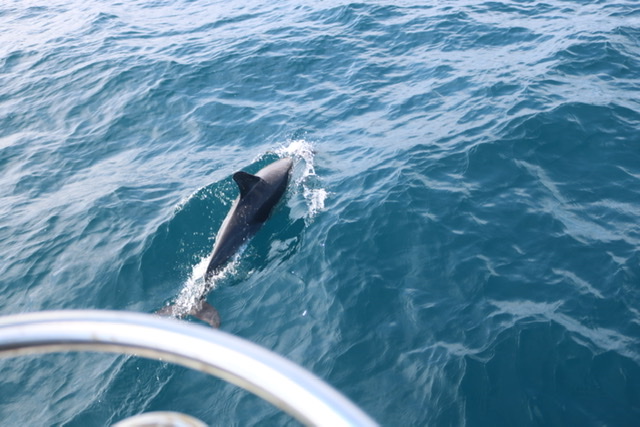
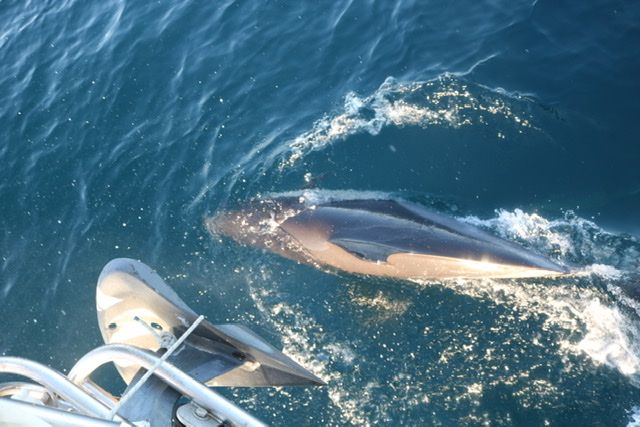
After two nights in Sines, we departed early in the morning for a long daysail, 60 nautical miles south and around Cabo de Sao Vicente, the “chin” of the Iberian Peninsula. But first…several times during the day’s sail we were visited by dolphins!
Dolphins ho!Riding the bow wake (Hazel’s anchor to the lower left).Bubble trail of this dolphin as it exhales and prepares to surface. Note the white sides, we’re thinking they were Short-beaked Common Dolphins.
The funniest episode of the morning was between dolphin visits. The three of us were in Hazel’s cockpit—Rhett and I sailing the boat and enjoying some coffee, and Sunny dozing on the windward cockpit cushion. Suddenly and from out of nowhere, about 10 feet to windward (upwind) a dolphin surfaces and blows a plume of spray in the air. Moments later and out of slumber, Sunny’s nose picked up the “fish breath” of the dolphin and she awoke with her ears perked and snout twitching, trying to discern the source of the intriguing animal smell.
Fim do Mundo
After the dolphins it was on to the fim do mundo or—in English—“the end of the world” (a.k.a., Cabo de Sao Vicente). The end of the world was the moniker given to this great cape by the Romans, Greeks and other ancients who inhabited the peninsula. In looking at the geography, it’s not hard to see why. One can picture ancient mariners and navigators sitting high above the water, on this southwesternmost point of Portugal and Europe, and looking westward with the known-world’s Mediterranean sea behind them and concluding that the horizon line of the Atlantic was the literal fim do mundo.
The Iberian Peninsula with Cabo de Sao Vicente (Cape St. Vincent) circled.
Sailing friends of ours had warned us that the prevailing northerly winds off the coast of Portugal significantly accelerate around the cape. To me, wind is always surprisingly affected by land features and from the above view it’s easy to imagine north wind flowing down the coast and being constricted (and thus accelerated) by the land to the west.
It was a mild sailing day, perfect for flying Hazel’s spinnaker. Still, as we approached the cape we considered dousing the spinnaker and going with our traditional fore ‘n aft sails (the “white sails”) in case the wind really exploded around the cape. As the cape loomed we considered and reconsidered our options. Finally, we decided to “go for it”—take the aggressive path—and keep the spinnaker flying.
One challenge with the aggressive path is that we had to gybe the spinnaker as we rounded the cape. “Tacking” is when the bow of the boat is brought through the eye of the wind (and sails momentarily lose their power and cross over to the new leeward side of the boat slowly and gently). “Gybing” is the diametric opposite: the stern of the boat comes through the eye of the wind and the sails gain additional power and, if it’s an uncontrolled gybe (a.k.a., a flying gybe), they come crashing across the boat at head-hunting speed. If you’ve ever wondered why the boom is called the boom, just keep your head down during a flying gybe or else you’ll find out the hard way.
Fortunately we had enough sea room to free gybe the spinnaker well before the rounding before the cape winds really kicked in.
Cape St. Vincent from a distance. Note that the spinnaker on starboard tack (flying off the port side) at this point.After the gybe we’re now on port tack (with the spinnaker flying to starboard). I decided to secure the mainsail’s lashings to the boom prior to approaching the cape.
Soon after my lashing mission on deck, our gentle day of sailing in a 10 knot breeze turned into a spirited romp around the cape in 18-20 knots of breeze. Hazel topped 8 knots of speed between the wind blowing, spinnaker pulling, and the flat water offering little resistance to her surging hull.
Our rounding of the cape/ The 24 meter lighthouse is was built over the ruins of a 16th-century Franciscan convent. Selfie time!Rhett and the “great cape.” I’m sure it’s in the top-10 list of great capes of the world!
A couple miles after we rounded, the wind settled down and we anchored for the night off the town beach of Sagres, Portugal.
Seven in the Afternoon
The southern coast of Portugal (between Cabo de Sao Vicente and the border with Spain) is the Algarve region—a summer holiday destination for Portuguese and international vacationers. After our night in Sagres we sailed 15-20 miles to the well run marina at Lagos. The marina was surrounded by good restaurants and between normal Portuguese prices and the strong US Dollar against the Euro, we visited many of them.
Rhett and I both tend to be “early to bed, early to rise” people—probably subconsciously making up for respective piles of past late-night sins. However, in Portugal we had to reset our circadian rhythms to fit with the evening dining schedule. We were talking about this one night while we were being served by an especially helpful waiter. Rhett commented to the waiter how good his English was. We got to talking further and asked him how he learned such good English. He said, “When I was a child I’d watch Cartoon Network from seven in the morning to seven in the afternoon.” Rhett and I looked at each other and chuckled. If seven o’clock is considered the afternoon, no wonder they eat at nine or ten.
He added, thoughtfully, “When I got to school, I could understand and speak English. Of course, when the teacher asked me to conjugate an English sentence, I didn’t know where to begin.” By the way he said that last sentence, Rhett and I knew that he assumed that we could conjugate an English sentence. We were relieved when the conversation moved on before he could ask us to conjugate.
Dinner in Lagos with the marina behind us.
As a quick side note, Portuguese late dining was just a warm-up for Spain. We walked into a Spanish restaurant the other night with plenty of open tables at 8:00 p.m. When we sat down, the waiter said with some consternation that the table we had selected had a reservation at 10:00 p.m.—we assured him we’d be done long before that!
Pirates of Cadiz
After Lagos, Portugal we set off on a 30 hour, 150 nautical mile sail across the Gulf of Cadiz to Barbate, Spain with the Moroccan coast only 100 miles or so south of us. While we could have made it a longer sail by hugging the coast, the Captain (in his infinite wisdom) chose the straight line and shorter path that would take us well offshore.
When people ask me what it’s like to sail offshore, my standard response begins with: “Have you ever been on a scary ride at Disney? In the ride’s car there’s a red button that says something like, ‘Press this button to stop the ride.’ Yeah, offshore sailing is something like that…except the ride lasts for days and there’s no red button.” While it’s my pre-rehearsed script, I try my best to make it sound unscripted.
While it’s been years and years since I’ve been on Disney’s Pirates of the Caribbean ride and I imagine the ride is updated, I’m sure the button is still there. All the while I thought I was making a funny joke—making light of some of the dangers out there. Me and my big fat mouth.
With 30 hours to sail, we set out from Lagos in the morning with the plan of sailing through the night and arriving in Barbate the next afternoon. I didn’t sleep much that night, I never do on one-night mini passages, I’ve got plenty of energy to see me through one night with some little naps here and there. However, I barely napped during the night between monitoring lots of shipping traffic in and out of the Strait of Gibraltar and a middle of the night sail change. The sun was just about coming up in the morning, and we were well offshore (no land visible). Rhett and I were both below decks when we heard the sound of a fast boat approaching. I checked out AIS scope…nothing. My first thought was that it was the Portuguese Coast Guard coming to check us out (often, military and law enforcement boats don’t transmit AIS). However, when I got myself on deck (Rhett wisely stayed below), I was confronted by a 20-25 foot rigid inflatable boat with two powerful outboards on the back. It was somewhat bedraggled and deflated, uniform gray in color, flying no national flag, and coming right at us—at speed…at 6:00 a.m. with no land and no other boats in sight. Hmmmmm…odd. In the boat were 6-8 young men, most with beards, a couple wearing motorcycle helmets (I still have no idea why).
At this point Rhett is—how we say—freaking out. The funny thing is that in most all situations, Rhett is the one who assumes best intentions about everyone we meet and I’m the cynic. However, on this morning (and perhaps because I was the one on deck with no other options), our roles were suddenly reversed. Rhett’s below decks and trying so hard to be quiet and calm she’s actually hissing through gritted teeth when she asks, “Who are they?” “What do they want?” I’m up on deck smiling and trying to hear what they’re shouting at me. Between normal ocean sounds, their outboards, their accents, and my hearing I have no idea. Finally, Rhett growls to me from below decks, “Dan, they’re shouting ‘Agua! Agua!’.” While Rhett is correct in what they are saying, I still have no idea what they want but I notice that the sole (floor) of their boat is packed with 5-gallon jugs. I wave them off with a smile shouting something like, “No thanks, we have plenty of water.” (I’m pretty sure that was a classic line of Captain Jack Sparrow’s in Pirates of the Caribbean 4…Dead Men Tell No Tales). Eventually, they wave and smile, floor their engines and speed away.
Who knows? Perhaps they wanted to sell us water (Rhett doesn’t’ believe that for a second). Perhaps they were checking us out (I like to think that my striking resemblance to Johnny Depp thwarted the attack). Perhaps they were running contraband between Africa and Europe and “Agua” was the code word for the drop. All’s well that ends well.
I was feeling kind of superior to Rhett the rest of the morning since I was the one with noble thoughts about our friends whereas she was the cynic. However, as soon as we approached land and picked up a cell signal and internet, she started searching the internet and found this post—suddenly I didn’t feel so superior.
Runway Modeling
Currently Hazel James, Rhett, Sunny and I are in the Spanish town of La Linea de Conception, just north of the Rock of Gibraltar. However, to get to Gibraltar, not only do we have to cross an international (and non-EU) border but we also have to cross an active runway…and I mean a real runway.
Hazel James to the lower left with the Rock of Gibraltar in the background.
I stress the “real” thing because this isn’t the only time we’ve had to cross a runway in our voyages. I guess it shouldn’t be too surprising as a lot of our land travel is on narrow islands and peninsulas, and runways need to be oriented to take advantage of a location’s prevailing winds.
On our last voyage to the Bahamas (Spring of 2022), on Cat Island we spent a night at a secluded marina and to get to the marina’s adjunct hotel and restaurant and beach we rode their loaner bikes across a runway. However, and to be fair, it was more of an air strip—private, and one or two small planes would land or takeoff per day.
Approaching the airstrip on Cat Island, Bahamas. Note the second sign to the left……here’s a closeup of that sign. It gave us a chuckle.Looking down the air strip on Cat Island.
However, the runway in Gibraltar was no joke. It’s used by commercial jetliners serving Gibraltar and Spain’s Costa del Sol, and UK Royal Air Force planes. In addition, a constant stream of automobile, motorcycle, petrol and electric scooter, and foot traffic crosses the runway. Just like at a US train crossing, when the light turns yellow, everyone races to beat the gate and get across before the next plane’s arrival or departure.
Rhett couldn’t miss the opportunity for some runway modeling.
Rhett and the Rock (Sunny on Rhett’s back). The car is on the road and the runway is stretching to the left and right.The same location but from a different angle. We’re now looking down the runway.
The Gibraltar…of Gibraltar
When I was in Bermuda after the first leg of my transatlantic, I toured many of Bermuda’s forts and gun batteries and learned that because it was so heavily fortified, Bermuda earned the nickname “The Gibraltar of the West” (see my Bermuda post here). This gave me an inkling that if I should make it to Gibraltar, I’d also see a lot of fortifications.
Our day of hiking on Gibraltar did not disappoint.
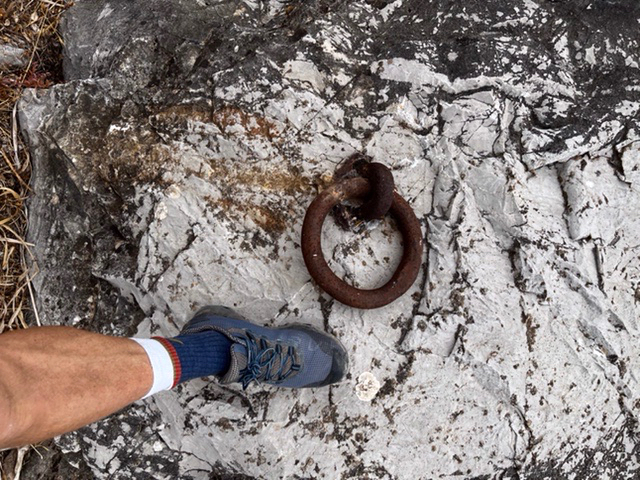
The Devil’s Gap gun battery halfway up The Rock.All along the roads up Gibraltar these iron rings were embedded in the rock to help soldiers haul cannons up the mountain.
While the guns were interesting, the tunnels in The Rock were amazing. While the most recent tunnel boring was done during World War II, earlier tunnels exist given The Rock’s strategic location and the many times it has been under siege in its history. Today, it’s estimated that there are 34 miles of tunnels in a land area of 2.6 square miles.
Here we are in an excavated storage cavern in The Rock.
A Pouted Round Mouth
In addition to Gibraltar’s history, geology, and views, it’s also home to 300 Barbary macaques—the only wild monkey population in the European content. That brings us to our next adventure.
A Barbary macaque on Gibraltar.
In today’s over protective and litigious world, I’m a firm believer that the vast majority of warning signs are overblown. Therefore, when I saw this one at the beginning of the hiking path up The Rock, I promptly ignored it.
Maybe I should have heeded this one?
In retrospect, I’d suggest some minor alterations to the wording of the placard…
Should Macaques feel threatened, they will warn you with a pouted round mouth indicating ‘No’ or ‘Stop’—or ‘Take one more step and I will rip your little dog’s head off and shove it down your throat!’ Calmly place your fiancée between you and the Macaque and run like hell.
Even though all licensed taxi drivers in Gibraltar are also trained and certified as tour guides and we heard they do an excellent job, we decided to hike up The Rock for some exercise. The day started well enough with the three of us walking on wide paths and roads. We saw a few troops of Macaques from a comfortable distance and all was well.
Then, for the final ascent to the summit, the footpaths turned to narrow Medieval-era stone steps and we had to put Sunny in her backpack. Rhett and I were trading off carrying Sunny as her 12 pounds got heavier and heavier as we got higher and higher. At the bottom of each flight of steps there were special placards further warning us that Macaques may become aggressive if they feel cornered while on the the narrow steps or adjoining ramparts—we read, processed the information, and kept climbing.
As we got to the last course of steps it was my turn with Sunny and, sure enough, there was an adult macaque on the steps well above us with two juveniles playing nearby. No problem we said to each other, we’ll take our time and they’ll move on before we get to their altitude. I was so unconcerned that point, and so close to the summit, I even hammed it up for the camera.
Note to self: NEVER declare an early victory when macaques are in your midst. I believe the macaque is thinking, “Bring it on, tough guy.”One of the juveniles on the rampart next to the steps. Getting closer with the adult on the steps.“Hmmmm, she doesn’t seem to be moving.”
Note in the last picture the crowd of people above us. I think half were walkers waiting to come down the steps, and the other half were taxi-tourists watching us to see what would happen next.
We edged closer, all the while thinking that the monkeys would get the hint and move along…after all we are American citizens and we won’t be stopped.
Finally, we were just about to decide that going further was a bad idea (as the macaques had started to take notice of us), when one of the taxi drivers from above yelled down, “Go back, the monkeys will attack your dog!” I’m not sure if Sunny was aroused by the yelling, or my tensing, or had smelled the macaques, or all three stimuli at once but she started to come to life and squirmed and twisted in the backpack trying to get a better look at the monkeys. As if on cue, as the cab driver’s words trailed off, the macaques started loping down the rampart…toward us. I was in front with Sunny and Rhett was behind me. Now, it was my turn to hiss between my teeth, “Rheeeeett, back up!…back up!” As I tried to retreat down the steps backwards, I felt my heels bumping into Rhett’s shins. Rhett would later say she couldn’t back up because she was too busy putting her hands over Sunny’s head to protect Sunny and keep the from making eye contact with the advancing monkeys.
Somehow, we got ourselves turned around and I got below Rhett and we started hustling down the steps. After about 30 quick and steep steps downward, I sighed, “OK, I think we’re safe.” and turned around to look. I croaked to Rhett, “Yikes!, keep going! They’ve still got the round and pouted mouth!” We retreated further and faster.
Finally, after a lot of steps downward in retreat, the macaques lost interest and we all breathed a sigh of relief.
Catching my breath after a close one. It looks like Sunny wants to do it again.
I’m happy to say that we were courageous enough (or foolish enough, take your pick) to be undaunted by the experience. Although we had given up several hundred meters in altitude during the retreat. We found a road to the top and the most dangerous thing encountered on the road were the taxis careening downward on it.
At the top of Gibraltar, we were finally rewarded with our view eastward over the Mediterranean Sea.
Looking east over the Mediterranean.
From Fado to Flamenco
We’ve taken in some great music while on the Iberian Peninsula, first with a fado dinner in Lisbon with three instrumentalists and a host of singers singing solos and together.
Fado night in Lisbon
Last Monday, the day after our day in Gibraltar, we were looking at the weather and decided that we’d be in the marina for the week with contrary winds. We considered our options for and inland voyage and decided on Sevilla. It was an amazing couple of days and only a 2 hour drive from Gibraltar. The highlight of the trip was a flamenco show at the Museo del Baile Flamenco. All of it—the guitarist, the two singers and percussionists, and the three dancers—were amazing.
Flamenco in Seville.
Tomorrow morning (Sunday morning) we’re planning to push further east into the Alboran Sea (the Western Mediterranean). The wind direction and weather don’t look great for making a lot of progress but we’re ready to move and are thinking we can get a 100 or so miles of easting in before some strong winds kick up on Tuesday evening.
(Author’s Note: I started writing this post almost a month ago, soon after I had completed the transatlantic sail and shortly after Rhett had arrived in Portugal. However, sailing, sightseeing, and spotty internet connectivity conspired to keep me from finishing and publishing it. Bottom-line, excuse any odd timing references.)
“So, when did you get to Portugal?” one of my harbormates at the Oeiras Marina asked. I replied, “About a week back.” However, the theme of this post is not, about a week back. It’s about a weak back.
In looking back on my third and final big passage of the crossing—7 1/2 days from Ponta Delgada, Sao Miguel, Azores to Cascais Harbor, mainland Portugal—it was a “tough sandwich.” While the beginning and the end of the passage was easy with beautiful weather, the stuff in the middle was an arduous chew.
Hazel and I started sailing midday on Thursday, June 30–a crystal clear day. The daylight hours were downwind and under spinnaker, as we sailed east and along the south coast of the island of Sao Miguel…ahhh, the idyllic beginning. I should have known that Poseidon was foreshadowing and wouldn’t give up his treasure that easily.
Leaving the town of Ponta Delgada in our stern wake in ideal weather. Note the distinctive, volcanic hills.Spinnaker flying a half hour later (can’t all sailing be like this?).Passing the island of Ilheu de Vila Franca and the town of Ponta da Sao Pedro to the left.How could the Ponta Garca lighthouse not remind me of all the lighthouses that Rhett and I saw and toured last summer in New England?
Just as I was about to clear the island of Sao Miguel (around sunset on day one) the wind almost died. For a couple hours I made slow progress to the east and when we were several miles off the island, the wind died completely. We were bobbing around on a glassy ocean while slowly drifting backwards toward the island. When we were just two miles off the island, I told myself, OK, if this keeps up and we get one mile from the island, I’ll need to switch on “Ox” (the engine) and motor away from the island. I’m a bit of a purist but I’m not crazy.
Thankfully, in the middle of the night—and before we reached the one mile threshold—a north-northwest wind kicked in and we were sailing again. While it felt great to be moving, and moving in the right direction, I had an inkling “it” was coming. The ”it” being that the north wind that I so desperately needed at that point would veer to the north and northeast and blow hard. We’d be ”hard on the wind” (sailing upwind)—the opposite of fair winds and following seas.
What I didn’t know early-on is that we’d be doing that sailing for the next five days under leaden skies during the day and dark, moonless and starless skies at night. While no one incident was absolutely crazy on the passage, it was a test of endurance. I had to work hard to keep eating well, and sleeping whenever I could, to keep my energy up and wits about me.
Although this picture of Hazel was taken by a French boat on our sail from Horta to Ponta Delgada, it’s what we would have looked like when the wind was “down” on our sail to mainland Portugal. Early in the passage, the 330 meter (1,80 foot) Nave Galactic bound for Rio and taking Hazel’s stern at a range of 2 nautical miles.Enjoying a cup of tea in the cockpit with a pretty good swell running and ”Otto” the wind vane steering us (It was cold, I’ve got thermal underwear and a sweater on under my foulies).Hazel’s saloon after many days on port tack (heeling to starboard). The yellow sail bag in the upper left is tied in place so it doesn’t roll downhill to leeward. Note the white ”lee cloth” set up on the starboard (leeward, downhill) setee where I could do my sleeping and keep an eye on the instruments (at the same time).Cooking was a challenge. trying to brew some brew some coffee in my Bialetti Moka Express and fry up some migas with broccoli. Times are never too desperate for a good cup of coffee and some solid eats.
Finally, after five or six days of this sailing and as we were approaching the coast of Portugal, the weather broke. That was all the good news. The not so good news was that we were also approaching the ”traffic separation zone” for north and southbound freighters and tankers off the European coast.
Commercial ships, like commercial jets, are expensive to run. They just don’t sail around the ocean randomly but generally stick to well established shipping lanes. Those lanes constrict and congestion results near ports and when rounding coastal features. a quick look at Lisbon’s location on the Iberian Peninsula makes it obvious why the waters off Lisbon are a congestion point for north and southbound ships off the coast of Europe.
Lisbon’s position on the the Iberian Peninsula (Hazel’s and my rough track in blue).
Fortunately my electronic charts clearly showed the south and northbound traffic separation zones.
Zooming in from the previous image, the ”nose” of Portugal to the right and the pink arrow showing the lanes that the south and northbound commercial traffic should stick to.
As I approached the lanes, my AIS scope started lighting up with ships and I felt like I was in a real life game of Frogger with consequences for a “Game Over” mistake. At least I was entering the shipping lanes mid afternoon with lots of daylight and excellent visibility. The other exciting news is that shortly before I entered the shipping lanes, I had my ”Land Ho!” moment—the European mainland.
There it is! The coast of Portugal (at a range of 30 miles or so). Yes—if you’re wondering—I cried when I saw it.Now, back to the task at hand: getting across the shipping lanes, first the southbound, then the northbound. The first southbound ship I encountered was the 182 meter (600 foot) Bahamian flagged Alhena bound from the Netherlands for Turkey.Shortly thereafter the 185 meter Liberian flagged UT Viken took our bow.
After working around a couple more southbound ships, we finally had 5 miles or so of respite until we reached the northbound lanes (the ”respite” being the shaded pink areas above). The situation got a bit tighter in the northbound lanes.
The northbound and gargantuan 399 meter (1,310 foot) Maersk Monaco off our starboard bow. I slowed Hazel down a bit to give us a bit more room.I breathed a sigh of relief to get the Monaco onto our port side. Note the coast of Portugal to the right.Happy to see her stern! She’s a quarter mile, or 4 1/3rd football fields, long.Late in the day, this LNG (liquified natural gas) tanker was my last close encounter.Finally! Through the shipping lanes and treated to our only clear sunset of the passage.
After the sun set on that cloudless day we were finally closing on the coast. We’d have no choice but to enter the River Tagus (the river on which Lisbon is built) and anchor in the darkness.
Although the day had been clear and warm, as soon as the sun set the temperature dropped again and I was back in thermal underwear and foulies. A couple miles off the coast I started encountering small commercial and recreational fishing boats with sketchy lighting so those miles were sailed with radar on and a constant lookout, trying to discern the lights of the shore from the fishing boats.
The most amazing thing of the landfall was that when we were just a quarter of a mile off the shore and still bundled up against the cold, out of nowhere a warm and dry wind from the shore flooded over us. Not only was the heat welcomed, but the air smelled! And it didn’t smell like salt and the sea, it smelled like earth. It smelled like animals (terrestrial animals), and grass, and rocks—all mixed with the fragrance of cyprus trees, cyprus oil, and cyprus wood. The air around me got so warm and so aromatic so quickly that I didn’t go below deck but immediately stripped down to my underwear in the cockpit grabbed the handrails on the trailing edge of Hazel’s dodger and leaned forward into the darkness and inhaled as deeply as I could—like a dog with its head out the moving car window (I imagine I would have been quite a sight in the daylight).
An hour or so later (about 1:00 a.m.) I set the anchor in the Bahia de Cascais (the Bay of Cascais) and slept. The next morning I motored several miles up the River Tagus to the Oeiras Marina (roughly pronounced O’ Iris) and checked into the marina.
Hazel at the reception pontoon in the Oeiras Marina flying her yellow Q flag.
To wrap up the loose ends on this story and to get back to the post’s title (A Weak Back). My arrival timing was excellent as I arrived on Friday, July 8 and Rhett and dachshund Sunny flew into the Lisbon airport early the morning of Monday, July 11. I “came in hot” to the marina. “Hot” on the adrenaline of having completed the transatlantic sail and the excitement of seeing Rhett soon (and nervous about the prospect of asking her to marry me). I stayed that way for the intervening days, busying myself with cleaning Hazel from stem to stern, and getting her looking her best for Rhett’s arrival. Yes I slept well but I felt a bit bulletproof and never really exhaled.
At 4:30 a.m. on Monday morning, I took a taxi to the Lisbon airport to be sure I’d be there when Rhett exited the doors of the international terminal. Finally, they both appeared—Rhett and Sunny—looking great despite the redeye flight. After our hugs and hellos, I took Sunny outside to find a patch of grass while Rhett got herself a coffee. After Sunny did her business outside I went to pick her up to carry her across the busy airport road (keep in mind that Sunny is a miniature dachshund and weighs all of 12 pounds). As I knelt down to pick her up, I twisted ever so slightly and as I began to lift her, I heard a squishy “pop” from within my body—my lower back to be precise. With a wave of pain and pins and needles, I knew I had done it—I had knocked my back out. While it’s not a big deal and I do it a couple times a year, it would have been a problem had it happened in the middle of the Atlantic. Hunched over in pain, massaging my back with one hand and holding Sunny’s leash with the other with taxis, cars, motorbikes, and scooters whizzing by, I thought about how this could happen now, after all the heavy lifting, punishment, and abuse my body had taken during the passage. It gives out lifting a mere 12-pound dog. I smiled (or perhaps grimaced) through the pain, I had to see the positive—how good my body had been to me throughout the transatlantic sail and how it was now screaming that it needed to exhale, it needed a rest.
Fair winds and following seas.
Oh…wait. Did I leave something out of this post? Do we have some unfinished business?
Ahhhhh yes…just what was Rhett’s answer to my marriage proposal?
Hi! Sorry about the recent radio silence but a lot going on aboard Hazel James and coordinating internet connectivity with my availability to write has been a bit of a challenge.
From a sailing perspective, we are on the move again! After 11 nights in the Oeiras Marina on the River Tagus (between Lisbon and the Atlantic), we set sail on July 19 and sailed to the Portuguese coastal town of Sines (the birthplace of Vasco da Gama). We then sailed around Cabo de Sao Vicente (Cape St. Vincent), the “chin” of the “face” of Portugal and Spain’s Iberian Peninsula, and anchored off the town of Sagres. From there a short sail to the summer holiday town of Lagos on Portugal’s southern Algarve region. After several nights in Lagos we did a 30-hour sail across the Golfo de Cadiz to Barbate (bar BAT eh). We’ll be departing Barbate in a few minutes on a 35-mile sail to Gibraltar. I think there some contrary winds will pin us down long enough we can make some proper blog updates.
As always our track is visible on the HJ Sailing home page.
That’s almost all for now…
You may be asking yourself, So, just what are the “forever implications” of all this sailing? The answer to that is simple, while we were in Lisbon, I asked Rhett if she would marry me!
If you’re wondering what her answer was (or why it took her so long to decide), I’d be happy to tell you now, but I’ve got to go a ready Hazel for sailing. Besides, I just love ending a post on a cliffhanger 😉
“Editor’s” Note: I started this post last night (Sunday, July 10). However, I’ve found that the most consistent thing about marina internet (regardless of the marina) is its inconsistency. Midway through drafting the post, the internet went dark and I went to bed. Therefore, I’m finishing the post on Monday morning and a careful reader may see some date inconsistencies. No worries, Im happy to say that in those few intervening hours, Rhett and Sunny have arrived and they are both sleeping off jet lag.
One hint to world travelers: If you really don’t like jet lag, just sail across the ocean—it’s as easy as that!
As you probably know from my satellite micro posts, unlike in most every movie about ships and the sea (Titanic, Jaws, The Perfect Storm, All is Lost, etc.) the boat didn’t sink and we made it! Hazel and I are transatlantic solo voyagers and are now tucked comfortably in the totally cool and fantastic Oeiras Marina (pretend it’s Irish when you pronounce it…O’Irish). It’s on the Rio Tejo (River Tagus) midway between Lisbon, Portugal and the Atlantic Ocean.
Hazel has enjoyed three straight “spa days” in the marina and although she took some knocks on the crossing, her evident pride in accomplishment more than makes up for any wear and tear. She’s the embodiment of “punching above her weight class,” and has never looked better as she awaits Rhett and Sunny’s arrival.
The marina has many local weekend boaters and on Saturday and Sunday a stream of friendly neighbors stopped by to ask, “Are you really from the US?” “Did you sail here?” “Did you visit the Azores?”
Before I get lost in the challenging passage from Ponta Delgada, Sao Miguel, Azores to mainland Portugal, let me do a quick rewind to our time on Sao Miguel. If you recall, I was a bit on the fence as to whether or not we should depart, and once we made the decision we left quickly—before I could give Sao Miguel its due via a proper post. In the end, I’m glad we departed when we did. Although the wind and weather wasn’t great on the eight day passage, it didn’t get any better over the week after. Also, the timing of me arriving several days before Rhett was perfect, giving Hazel and me a chance to rest and get ourselves cleaned up.
By a considerable margin, Sao Miguel is the Azore archipelago’s largest and most populous island (Sao Miguel’s population is 140,000, the other eight islands have a combined population of 100,000).
Sao Miguel as I approached from the west and from Horta.
After getting Hazel in the Ponta Delgada marina, cleaning her up, and attending to a few boat projects, I had a couple days of exploration before departure.
Hazel tidied up in the marina with Azorian capital buildings in the background.
Day one of exploration was in the town of Ponta Delgada and I started in the town square and by climbing the town’s bell tower that in the past was used to notify citizen’s of emergencies, curfews, etc. (piracy was a constant threat in these remote islands).
Town square.View of the marina from the town’s bell tower (red circle around Hazel).Zooming in with Hazel James front and center.
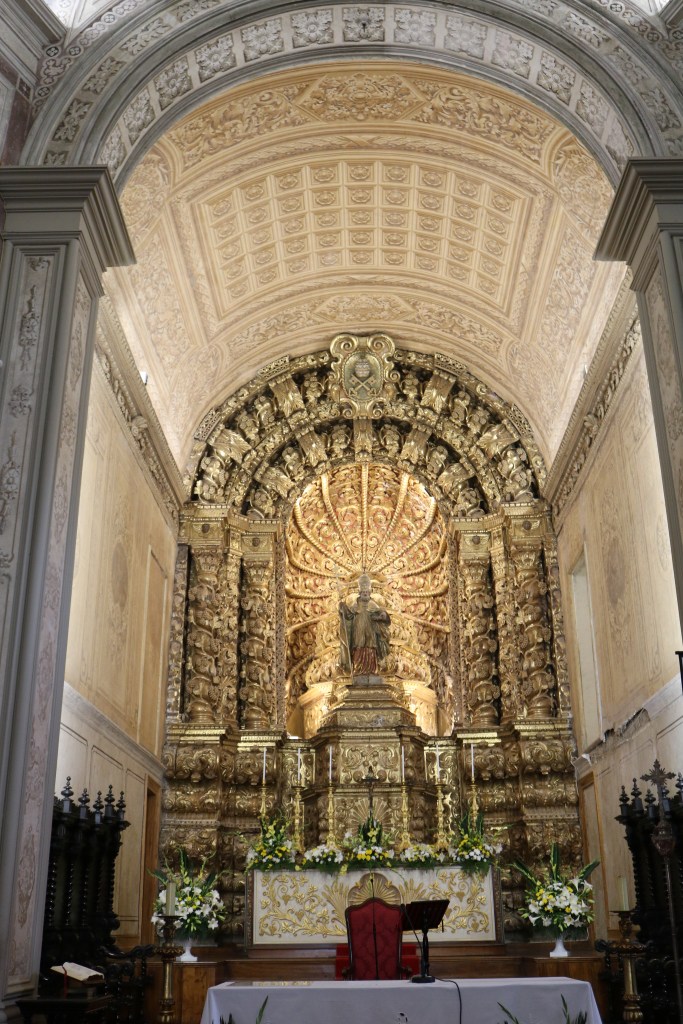
Just a couple blocks away from the touristy waterside streets was a dizzying array of cobblestone alleys running in all directions. I was especially taken with the number and beauty of the churches. It seemed like every few blocks was a different parish. They all had a similar external architecture of white stucco offset with dark timbers and were incredibly ornate inside. Sitting in a pew for five or ten minutes was a welcome respite and a chance to reflect on the miles behind me and the miles yet to sail. I just loved the smells of the churches—all the same, but all a bit different—a mix of wood and stone, salt air and humidity, incense, and years and years. I inhaled deeply trying to imprint each in my mind so I could eventually see if mainland Portuguese churches smelled similar.
Church bell tower taken from the town’s bell tower (just about to strike noon).Another church.View of the harbor from the gardens of the previous church.Sao Pedro (St. Peter’s) church.The main altar inside Sao Pedro.Another altar within Sao Pedro (just to the left of the main altar).
On day two of my exploration I wanted to get out and see the western end of the island. If Rhett were with me, we probably would have rented a car. However, while I rather enjoy eating dinner alone in a restaurant accompanied by a good book, the prospect of renting a car by myself seemed utterly depressing. Besides, what would the car-rental person think as some creepy loner filled out the paperwork? What’s this guy going to do with the car? I might as well have asked to rent a van with no windows and see what they thought of that (probably surreptitiously call the policia). To avoid that whole situation, I hired the taxi driver Marco to drive me around for several hours. We had a great time and while Marco’s English wasn’t the best, it was far better than my four words of Portuguese and we were able to communicate and have some fun.
Sao Miguel with taxi tour drawn in (north is up). The city of Ponta Delgada on the southern shore of the island is underlined.
As previously discussed in my Horta and Faial post, the archipelago of the Azores sits atop the Azores Triple Junction where the boundaries of three tectonic plates intersect: the North American Plate, the Eurasian Plate and the African Plate. As on the island of Faial, the evidence of plates colliding and separating and geologically recent volcanic activity dotted the Sao Miguel landscape.
Climbing into the foothills of Sao Miguel. Note the Hydrangea flowers in the foreground.Aqueduct that was used to bring water from the hills to Ponta Delgada.
Next we drove into the Lagoa das Sete Cidades Nature Park with its many inactive volcanic calderas (from the Latin, cauldron) that have filled with water forming picturesque lakes (lagoas).
Lagoa de Santiago in the foreground.Another caldera.Lagoa Verde in the foreground and Lagoa Azul in the background. Marco told me that in direct sunlight they are indeed green and blue (driven by the different dissolved minerals in each). Unfortunately we couldn’t see the colors with the overcast sky. Note the town of Sete Cidades in the upper left.Here’s a picture of the two lakes from the internet.Path to scenic overlook.
Marco next drove me down into the town of Sete Cidades where we stopped and walked around for a bit. While the churches in the “big city” of Ponta Delgada were much more ornate, Sete Cidades’s parish church, Igreja de Sao Nicolau built in 1857, possessed a simple, country beauty.
Walkway leading to the church. Note more hydrangeas.Inside the church.
To conclude our tour Marco drove me along the stunning north and west coasts of the island.
Cows on the way to the coast. Azorian cheeses are amazing (those are clouds on the horizon line, not land).North coast town of Capelas in the background.Another seaside town with the ubiquitous hydrangeas in the foreground.
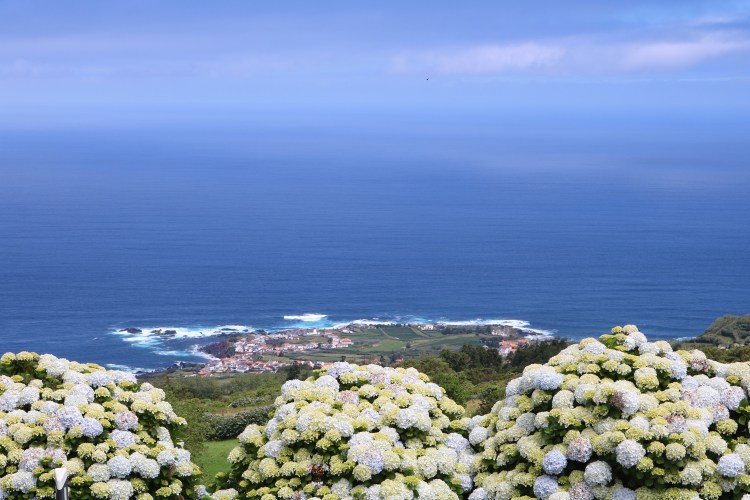
A final note on the hydrangeas, or as the Azorians would say hortencias, they are the national flower and literally line every roadside.
Hortencia (hydrangea).
I settled up and said my adeus to Marco (my goodbye, literally “to God”). When he asked where I was going next and I said mainland Portugal and Lisbon, he reflected, “I no like Lisbon. Here, life is good. There, too much stress.”—enough said.
Thanks as always for tuning in and we’ll work to get out a post shortly about the passage to the Iberian Peninsula and Rhett and Sunny’s settling back aboard Hazel.
Any sailor whose been to Horta or anyone who has researched sailing there has seen or heard of the tradition of painting a mural on the seawall in Horta Harbor celebrating the accomplishment.
Frankly, being a singlehander with lots going on, I wasn’t motivated to do it. It seemed like one more thing that someone else was telling me what to do (I don’t react so well to things like that). However, my perception changed when I heard it was bad luck to not paint a mural.
Still, seeing all the other murals put my accomplishment in perspective. While I’m happy with what I’ve done, lots of others have done it. However, if I could somehow filter through all the yachtsmen who have done it singlehanded, in a 31’ boat, and without using the motor—I’m sure the list would be a lot shorter. Regardless, there’s a lot of wisdom in the phrase, “Comparison is the thief of joy.” I’m happy for Hazel and me, and what we are doing and how we have done it.
One funny thing is that when I acquired Hazel James in 2017, I acquired her from the estate of the previous owner…unfortunately, he had passed away. Therefore, I never had the chance to talk to him about her history. Whenever I walked the walls in Horta, I was scanning murals just in case I saw Hazel’s name from the past—no such luck.
Just ONE wall in Horta with all the murals over the years (there are several such adorned walls).The spot I chose with my white background painted and drying (red arrow).Done! I actually enjoyed the process and found it meditative—reflecting on the passage as I painted.In good company.Just gotta have a selfie in this situation!
Enough about the past. In half an hour, I will slip Hazel’s lines and depart Ponta Delgada for Lisboa (Lisbon). I was back-and-forth on departing today or waiting a few days.
There’s a gale brewing in southern Biscay Bay, north of where we plan to sail and we will get some of the effects of it—I’d say some winds in the mid 20 knots with gusts to the low 30s. Not great but nothing crazy either. However, the wind direction gives me pause. I need to make an overall course of about 85 degrees (true) in order to make Lisbon (due east is 90 degrees). The wind is to vary from north-northwest to northeast during my sailing. It would be much better if it were from the west or south but we can’t have everything. However, as I looked at departing in several days instead of today, although the gale would relax and give me more mild winds, the wind direction will be a bit more from the east (bad)—so, I’m departing today.
Please keep an eye out for my upcoming satellite micro-posts on the home page of the blog.
Wish me Fair Winds and Following Seas! Thanks for all your support.
PS: In the spirit of the Hazel’s Horta mural and as much good luck as possible, I ate all the bananas on board this morning.
I think that bananas are only bad luck if they are outside of you.This “Featured Image” for the post is from our sail from Horta to Ponta Delgada. The volcano Pico is to the left and (obviously) the sunset to the right.
I’m a big hockey fan and there’s a pretty good—but not perfect—analogy to my current situation. If a solo crossing of the Atlantic is my Lord Stanley’s Cup, I’m preparing for game five of the best-of-seven series. I’ve got what sportscasters might say is a “comfortable” 3-to-1 lead and I just need to win one more game to hoist the Cup. “Comfortable” per the sportscaster, not so comfortable for the wise coach and team captain.
The rhumb line (straight line on a map) from Ft. Lauderdale to Bermuda was 920 nautical miles (nm, multiply by 1.15 to get land-based miles), and I sailed 1,015 nm to achieve the goal; Bermuda to the Azores (the big one) was 1,800 nm rhumb line and for me was 2,223 nm of sailing. By comparison, from the eastern Azorian harbor of Ponta Delgada on the island of Sao Miguel to Lisbon, Portugal, is 770 nm rhumb line. I’ve taken a few licks here and there so I wouldn’t say that I’m up 3-nil against my “opponent,” but I’ve fared well enough that I’d say a 3-to-1 lead is a good approximation.
The analogy starts to break down when I consider: Who, or what, is my opponent? I’m certainly not doing battle against the sea or against Poseidon, that would be a first-order fool’s errand…end-of-sentence. The analogy further breaks down when I realize that the “games” are not necessarily played sequentially. If a hockey team who is up 3-to-1 in a series has a bad night in Game 5, they can only end the night up 3-to-2. Conversely, a combination of a couple poor decisions by me and gale or storm coming from nowhere, mixed with a little bad luck and I could lose three games in a night and end up the “loser” of the series very quicly. Often when I think of Colleen’s struggles in her later years, I’m reminded of the quote, “Life has to win every day, but death only has to win once.” My situation is a lot different and I wouldn’t call sailing across the Atlantic death-defying, but the comparison is there.
The bottom line lesson for me from the analogy is that I need to keep my head in the game and not take “victory” as a sure thing or for granted, and recognize that I still have a significant sail in my near future. A few years ago, I would have thought of 770 nm of open ocean as incomprehensible. My four rules stand: 0 – Don’t freak out, 1 – Take care of yourself, 2 – Take care of your boat, 3 – Keep the boat moving in the general right direction (the unwritten corollary to these four rules are to not expend energy on anything else when passage making).
With all that being said, here are some pictures from Hazel’s and my passage from Bermuda to the Azores…
Sometimes it seems that long-distance sailing is nothing but a spectacular procession of sunrises and sunsets.Another. Without a time stamp, it’s hard to tell if it’s a sunrise or a sunset.I saw tens of thousands of Portuguese Man-o-Wars. One morning I woke to one having been splashed up on deck by a big wave.Uh-oh! The slimy blue stuff is broken off Man-o-War tentacles stuck to a spinnaker sheet. Yet one more hazard to watch out for.The shearwaters (both Corry’s Shearwaters and Great Shearwaters) were amazing to watch. Although it happened too fast to see in real-time, this picture shows the left wing tip dragging in the water just the slightest bit. It seems like they feel the water as they fly. Me preparing to go on deck in some sporty conditions.Finally! Dolphin sighting on my last day of sailing. I think these are Short-beaked Common Dolphins.As a sailing friend said, “Heartwarming.”My first view of the 7,700 foot volcano Pico at a range of 77 nm. The first land I had seen in 20-odd days.Pico without the telephoto lens. Just barely visible if you pinch-in.Approaching the town of Horta on the island of Faial.Hazel at anchor in Horta harbor awaiting clearance into the country (Pico in the background).Hazel in the marina with Pico in the background.Another of Hazel in the marina (she’s in the first row, middle-left). While I’ve done something big, it’s humbling to see how many others are making the transatlantic as well.
It’s interesting with all these miles of sailing that fittings, lines, and other sundries that would last for years of coastal and weekend excursions on Hazel James chafed and wore considerably. Although she was designed, engineered, and built to be a long-distance, blue water (off shore) cruiser, when I first acquired her I probably sailed her every other weekend and maybe for a 15 nm per sail. That would be 390 miles of sailing in a year, and in relatively benign conditions. Given the 3,000+ nm of sailing I’ve done already this voyage, and doing it in whatever wind and seas that Poseidon threw at me, Hazel has seen “ten years” in a matter of months. While, in general, boats like to be used and don’t like to sit idle, I’ve got to be diligent (and keep my head in the game) when walking the decks and looking for wear and chafe, and addressing the situation proactively.
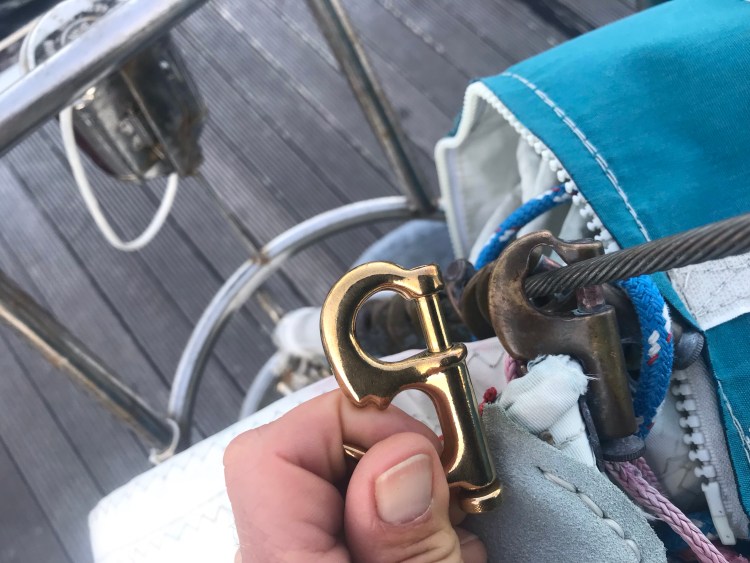
These fittings are called “hanks” and they attach the headsails (ahead of the mast) to a stainless steel stay. The hanks are designed to be softer so they wear over a long time and the stay does not abrade. If you look carefully, you’ll see how thin the hank is at the top (there was virtually no wear on it prior to leaving Florida). New hank in my hand.Comparison of old sailing glove to new sailing glove.
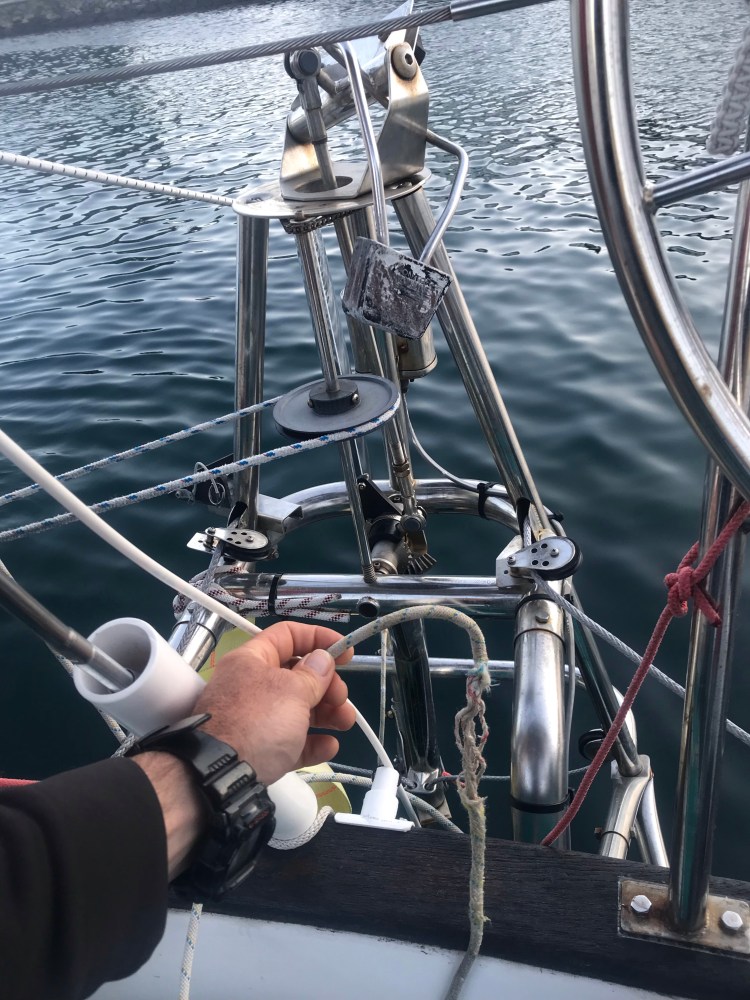
On the open ocean, I’m only actively and directly steering the boat about 1% of the time. For the rest, she’s steering herself. Her main long-distance steering mechanisms use the power of the water rushing past her to control lines that are attached to her steering wheel. There’s a good video of this that I did several years ago here. Those lines took a lot of chafe on the passage.
Here’s a steering line that has been totally chewed up by the constant motion past a sheave (a pulley).
There’s an analogy in here to the emotional wear and tear on me over the days and days of sailing. A happy diversion was to think about the subject of my nightly satellite post (and thank you all for reading!). Thanks all to Rhett and close friends who sent me well-meaning and supportive messages that I totally misinterpreted during some of my low points.
Since arriving in the Azores on Wednesday, June 15 I’ve been in the Horta marina on the island of Faial. While I had grand plans to visit most all of the other nine islands of the Azores and climb the volcano Pico Alto on the neighboring island of Pico, the weather has conspired against those plans. While it’s disorientating to say so, I would liken the weather over the last week to springtime in a high-altitude US Rocky Mountain ski town. It’s bizarre to say that it feels “alpine” at sea level. The temperature has been in the 60s (obviously Fahrenheit) with patches of sun. However, as soon as I get excited about the sun, dark clouds and misting rain is driven through by the relentless and strong northeast wind. Locals assure me that this weather is unusual but we’ll have to see on that. I tend to believe them because—in addition to being locals—the prevailing wind that we should be experiencing (and what I need to get me to Lisbon) is from the southwest.
In addition to cleaning up Hazel and boat projects, I’ve been doing a lot of hiking and touring of local museums on Faial with Welsh and Dutch friends I originally met in Bermuda. Spending days with friends from other countries is so enlightening. I’m happy to say that at the age of 57, I think I am finally understanding the nuances between the geography, political organizations, and countries of the British Isles. I find myself repeating back to my always-patient friends what they have said to make sure my understanding is reasonably accurate. It makes me want to go back to grade school and high school and pay attention this time in my geography and French classes.
The geography and geology is amazing here as we are at the Azores Triple Junction (the ATJ for those in the know). It’s where three tectonic plates intersect: the North American Plate, the Eurasian Plate, and the African Plate. Thus islands in the middle of the sea and amazing amount of both “recent” and not-so-recent volcanic activity. Many of our hikes have been over and around calderas (large cauldron-like hollows that forms shortly after the emptying of a magma chamber in a volcanic eruption), lava bubbles, and even new land that has risen out of the sea in the last 70 years (a true geologic blink-of-the-eye).
Classic Faial countryside. It’s very pastoral with farming, cows, cheese, etc. You’d never know you were on an island in the middle of the Atlantic.Looking northeast, down on the town of Horta and the harbor. Hazel is in that forest of masts. The picture was taken from the top of a double-caldera.Looking south (the other direction), across the Atlantic from close to the same spot where the previous picture was taken. the double-caldera shape is clearly evident.Horta as viewed from the opposite direction (looking to the south). The double-caldera in the previous picture is to the left. Castelo Branco, a lump of lava out over the Atlantic. Made for some great hiking.Volcanic sand beach.Rugged, lava coastline.
These next couple pictures are from Capelinhos on the western end of Faial. The lighthouse used to be like most lighthouses—on the coast. However a 13-month series of eruptions started in 1957 and left the lighthouse more than a mile from the ocean. Unbelievable. I remember from school days that geology and geography seemed so old. Like nothing ever happened. Not so when you are where three tectonic plates meet.
Lighthouse in the foreground. “New” land in the background right.From a different view.
This morning Hazel and I plan to “lace up the skates” and depart on a 150 nm sail east-southeast from Horta on the island of Faial, past the island of Pico to Ponta Delgada on the eastern Azores island of Sao Miguel. Given Hazel can make 120-130 nm in a good 24 hour sail, I’m hoping to arrive in daylight.
The islands of the Azores with my navigational notes. The red arrow indicates my intended sail over the next day and a half.
In Ponta Delgada, I’ll enjoy Sao Miguel, rest, provision, and wait for a good weather window to embark on my 7-10 day sail to the Lisbon area and mainland Europe.
It’s interesting, and in retrospect not surprising, that while my sail from South Florida to Bermuda was a bit lonely, my longer sail from Bermuda to the Azores was quite “social.” Bermuda is a focal point in the western Atlantic where many sailing yachts from the Caribbean, US, and Canada layover before pushing on the long sail east. Also, St. George’s Harbour in Bermuda is relatively small, promoting a feeling of kinship. Fellow sailors in dinghies motoring or rowing past Hazel were constantly stopping to talk. In addition all of boats in the focal-point of Bermuda had a common destination: the Azores, and we departed in “clumps” coincident with good weather. Through high frequency radio and satellite email, a group of five boats that departed with Hazel all stayed in touch throughout the crossing and I had instant friends in Horta.
I’m afraid that this last leg may be a bit lonely as well. Boats departing the Azores are all headed to different destinations in Europe, the Mediterranean, and other Atlantic Islands. In Ponta Delgada, I’ll be asking around with other boats to see if I can connect with others who are headed to Lisbon or other ports nearby on the Portuguese and Northwest Spanish coast.
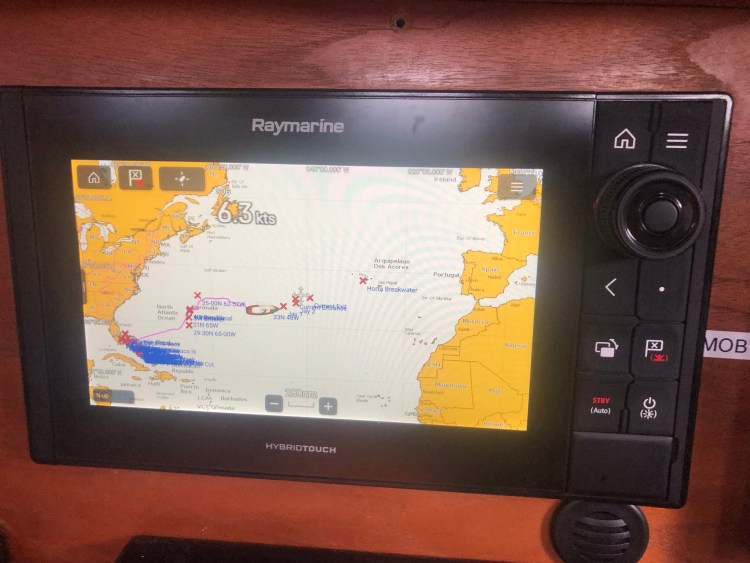
View of my chartplotter (GPS) when in the middle of the Atlantic. You can get a sense of Bermuda being a focal point while the Azores (red “X” to the right) is a divergent point with Europe-bound boats heading in many directions.
Rhett and Dachshund Sunny have plane tickets to arrive in Lisbon on July 12 and I really want to be there to meet them when they arrive. However, in the spirit of keeping my head in the game, and in this 3-games-to-1 “lead” that I have, I’m going to be careful to wait for “the right” weather window to embark (or, better said, a “good enough” window). While the weather window will never be totally perfect, in the excitement of the prospect of rejoining with loved ones, it’s important to not look at the weather charts, squint your eyes, and pretend to see what you want to see and sail off into immediately dangerous conditions.
In my sail, I think it will be important to conserve energy (and sleep) early in the sail. When I approach mainland Europe I anticipate encountering a lot of both big ship traffic and small (often not well marked) fishing vessels. I’ll need to be alert on those last couple nights of the sail.
Wish me luck when the puck drops. Hazel James out.